BB/11. Time is Hollow, and There is Nothing Around It
One of the four strands of the Borštnik Theatre Festival is the Student Theatre Program, which allows students of the Academy of Theatre, Radio, Film and Television (AGRFT) to present their semester, diploma, and master's productions to festival audiences. As part of this program, the Borštnik performative event (#80yearsAGRFT) took place, documented by Manca in Entry No. 7. In a few hours, the online exhibition AGRFT 80, organized by the Centre for Theatre and Film Studies of the University of Ljubljana's AGRFT, will also open.
But let's begin at the beginning.
First, I am going to steal last year's idea for entering a text. Two days ago, I too watched the production 1973. That was a year before I existed. It was also a year before my mother existed. And yet, somehow, both of us were present there, in a way. We often imagine the future as a distant landscape toward which a train is speeding. Or as the current of a river that you can never outrun because it is always one step ahead of you. Or as something that will arrive once the present has already departed. But what if the future does not exist and never will arrive? I do not mean this in a pessimistic or apocalyptic sense, but rather as a question: what if the future has always already been here? Perhaps the future is something that is constantly coming into being and is most alive and active precisely in the present. In 1973, the creators weave together the present, the past, and the future. I am trying to remember the text Tamara speaks at the beginning of the performance, but I am not doing very well ... Something along these lines: It is 1973. In 1982, Tamara will marry her sister's husband. But today, nobody knows that. Today, nobody suspects it. (My memory tells me it was something similar. Correct me if I am wrong.) And I absolutely agree with this. All the seeds of our future already exist in this moment, in various forms.
But let's begin at the beginning.
On one level, student theatre can also be understood as the theatre of the future. It offers a point of entry into the processes, productions, ideas, and performances of the youngest generations of artists, who are only just beginning their professional journeys. One day, the festival's Competition and Accompanying Programs will be filled with the work of precisely these generations. One could write many things about these productions—reviews, reflections, interviews, analyses, and so on. But this time, I am taking the opportunity to use them as spaces for reflecting on time, which is always already here, even though "it is hollow, and there is nothing around it."
But let's begin at the beginning.
SCENES FROM EVERYDAY LIFE
Production of the 2nd Semester of Acting and Theatre & Radio Directing, UL AGRFT
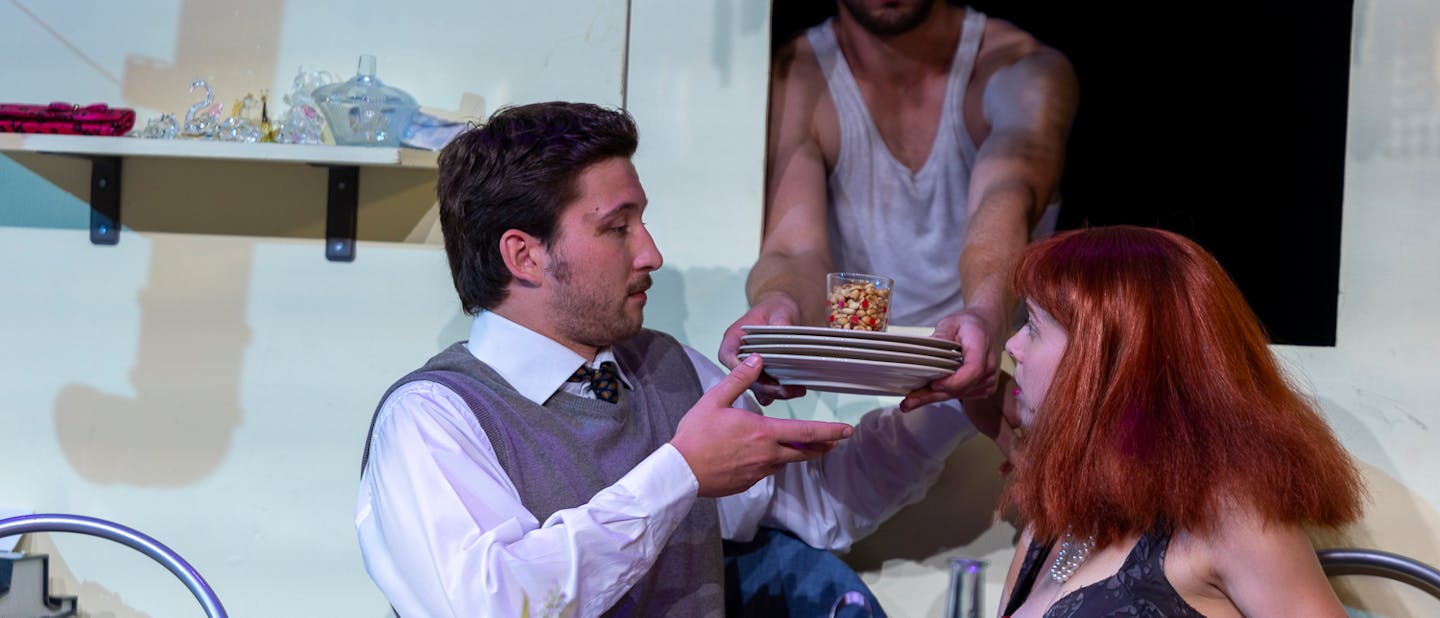
Scenes from Everyday Life is a performance built from three parts, three different situations, and three first-year directors. In one, we follow a family situation in a local inn; in another, a blend of dreams, reality, and perspectives in an apartment that extends beyond its walls; and in the third, we witness a 60th birthday celebration where old wounds reopen and new ones are created. The future most often hides in the most banal moments. We like to imagine major changes as dramatic turning points, yet our lives are in fact shaped by everyday gestures, routines, and relationships. In this sense, everyday life is not the opposite of history but its quietest mechanism. It is precisely there that habits, desires, and worldviews are formed—things that will one day become something larger than themselves.
A MIDSUMMER NIGHT'S DREAM
Production of the 4th Semester of Acting and Theatre & Radio Directing, UL AGRFT
In A Midsummer Night's Dream, the future appears as a space of unpredictability. The world of the performance is driven by coincidences, mistakes, desires, and forces that escape rational control. It is interesting how often we try to understand the future as the result of planning, even though it is also shaped by unexpected turns, encounters, and affects. Perhaps the future is not only what we build, but also what surprises us. In another Shakespeare play, Prospero says: "We are such stuff as dreams are made on, and our little life is rounded with a sleep." The second-year students played with different spaces and reopened ancient questions of fate and determinism, which perhaps contain some magical powder for the future.
CAT ON A HOT TIN ROOF
Production of the 6th Semester of Acting and Theatre & Radio Directing, UL AGRFT
The third-year students, who spent the semester working on two creative processes, explored questions of time, determinism, and the future (indirectly) through the American realism of Tennessee Williams. Cat on a Hot Tin Roof can be read as a drama of the future that its characters attempt to control before it happens. Family relationships are saturated with questions of inheritance, succession, and continuity; the future appears as something that must be secured, directed, or appropriated. Yet the more the characters try to control it, the more its uncertainty is revealed. Beneath the surface of family conflicts lies the question of whether the future can truly be planned at all. The performance therefore functioned as a reflection on humanity's desire for certainty: the need to translate life into clear stories, relationships, and legacies, even though reality repeatedly confronts us with the unspeakable, the unpredictable, and the elusive.
THE GLASS MENAGERIE
Production of the 6th Semester of Acting and Theatre & Radio Directing, UL AGRFT
If Cat on a Hot Tin Roof speaks of the future as an object of desire and control, The Glass Menagerie raises the question of the future as a fantasy. Williams's drama is constructed from memory, but not as a nostalgic return to the past. Rather, it emerges as an attempt to understand something that never truly came to pass. Its characters live in constant orientation toward something that is supposed to arrive: a better life, a different fate, the possibility of escape. Yet the future remains largely a promise that continually recedes. This is where the play's particular melancholy resides. It reminds us that people do not live only from memories of the past but also from the images of the future they create for themselves. When those images collapse, we lose not only a plan for moving forward but also a part of our identity.
PERŠMAN (A STUDY)
Production of the 8th Semester of Acting, Theatre & Radio Directing, and Dramaturgy & Performing Arts; Diploma Production
The diploma production by the fourth-year students also featured first-year acting and directing students. Through the symbolic presence of seventeen performers, they represented the Peršman homestead—the home of the Sadovnik and Kogoj families—located east of Eisenkappel (Železna Kapla), high beneath Mount Peca. Initially, we find ourselves in April 1945. At the beginning of the story, where catastrophe occurs. In the early morning hours of 25 April 1945, an SS police regiment murders a family of civilians. Eighty years later, an anti-fascist youth camp takes place on the same site. The Austrian police conduct an extensive raid on the camp that lasts several hours. Within the context of thinking about the future, the performance served as a reminder that the future cannot be conceived without historical memory. While we often understand the future as movement forward, the performance demonstrates how deeply that movement is intertwined with what remains behind us. History is not presented as a closed chapter or an archive of past events, but as an active presence that continues to shape how we understand ourselves, our communities, and the world. The performance raises questions of intergenerational transmission: how traumatic experiences, violence, and loss are carried through time and become part of the collective imagination even for those who did not experience them directly. In an era that often privileges novelty and understands the future as a departure from the past, Peršman (A Study) insists that no future emerges from emptiness. Every society builds its future from the memories it preserves, as well as from those it pushes to the margins of visibility. In this sense, the performance is less a look backward than a reflection on responsibility toward the time to come.
I, DAVID
Production of the Master's Program in Theatre and Radio Directing (Theatre Directing Track), UL AGRFT, in collaboration with Maska Ljubljana
I, David shifts the question of the future to the level of the individual and their relationship to their own identity. While the other productions often opened questions of community, family, or history, here the focus is on a subject attempting to establish their position in the world. Yet identity is not presented as something stable or fully formed; rather, it appears as a process of continual becoming. The performance creates space for reflection on how individuals construct their futures through the stories they tell about themselves and through the images they imagine of who they might become. The future therefore does not appear as an external circumstance waiting somewhere ahead, but as an inner horizon that guides decisions, desires, and self-understanding. In this regard, I, David offers an intriguing reflection on contemporary subjectivity: the individual who is constantly confronted with the task of defining, reinventing, and situating themselves in the world. Their destiny is not something predetermined, but something that emerges through the very process of seeking an answer to the questions: Who am I? and Who do I want to become?
But let's begin at the beginning.
If we were to summarize this year's student program through a single temporal gesture, it would be difficult to describe it simply as the future. More precisely, we watched a present that continually flowed into its own possibility. In this sense, the future was not the subject of the performances but their mode of existence. It appeared not merely as a theme but as a structural element: a way in which the present opens itself, gives itself form, and simultaneously exceeds itself.
This also means that the future is never entirely separate from what already is. It is not a pure transition into something else, but a difference that emerges within the same time. In every performance, the same question was outlined: not what will be, but what is already becoming.
And perhaps this is the quiet common point of all these very different productions—that they did not search for the future, but each, in its own way, already thought of it as a present possibility within the now.
But perhaps there is no beginning.
And you simply have to keep going.
See you soon!
Nika Šoštarič (reporting this time from the future)
*prevedeno z DeepL AI/translated with DeepL AI. This text was translated from Slovenian using AI tools solely to ensure international accessibility. As a festival that deeply values human creativity and authorship, we thank you for your understanding regarding any linguistic or contextual imperfections.