BB/17. BBB or: Bye Bye, Borštnik
See You When the Earth Orbits the Sun Again
Every festival has its beginning. That moment when the theatre doors open for the first time, when people start gathering in the foyer, when a programme transforms from a list of titles into a living event. It is much harder, however, to determine its end. Is it the final applause? The last award presented? The final review published? The last late-night festival conversation, when questions seem larger than answers? Perhaps the end of a festival only truly arrives when we return home and realize that something has stayed with us.
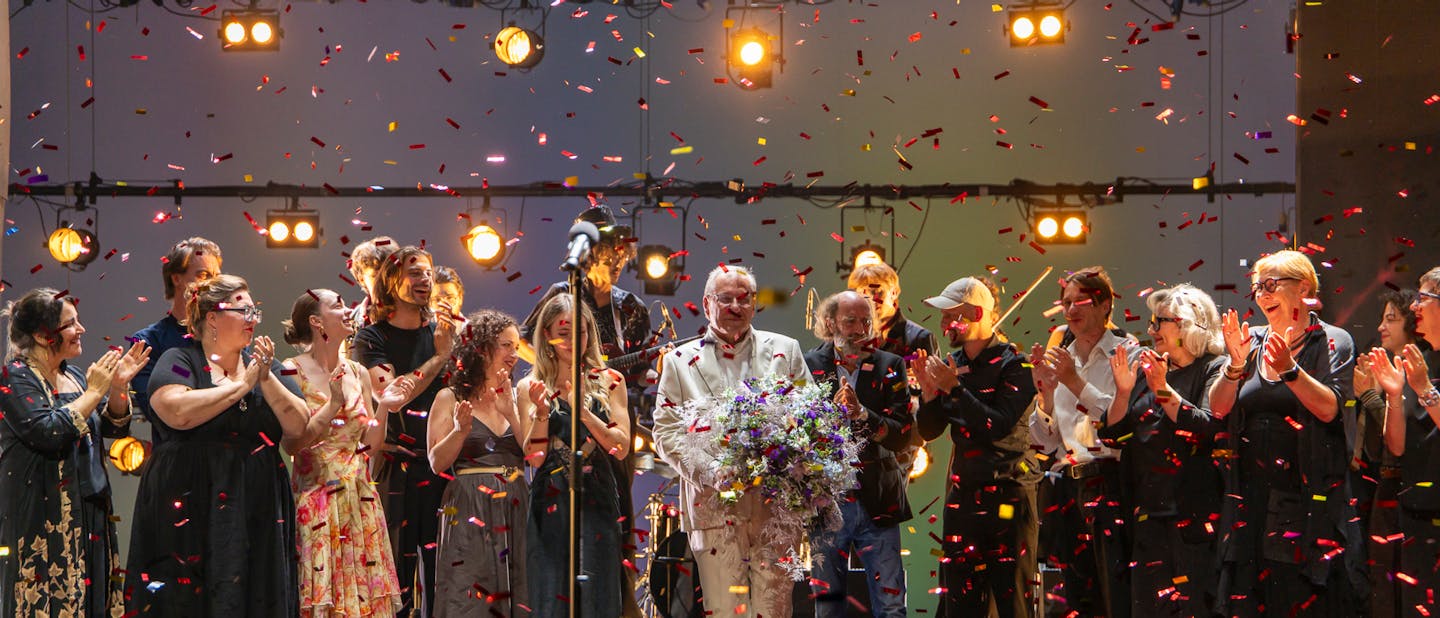
This year, the Borštnik Theatre Festival bids farewell once again. For the 61st time. After two weeks of performances, encounters, reflections, excitement, disappointments, surprises, and discoveries, it almost feels strange that it can all come to an end so simply. The lights go out, the auditoriums empty, accreditation badges find their way into drawers, and the rhythm of the festival slowly dissolves back into everyday life.
Yet theatre has never been an art of permanence. Its uniqueness lies precisely in the fact that it exists in the moment. It cannot truly be preserved. A performance comes alive among people, in a specific place and time, and then disappears. What remains are memories, notes, photographs, and feelings. What remains is that elusive something that keeps drawing us back year after year.
Looking back at everything I—and my colleagues Lana, Manca, and Doroteja—have written about, it seems that similar themes kept resurfacing through different performances and different festival moments. Time. Memory. The body. Community. Presence. Absence.
We wrote about performances that invited us into the past and others that compelled us to think about the future. About stories of individuals and stories of societies. About theatre as a space of resistance, a space of play, and a space of questions. Sometimes we left the auditorium full of enthusiasm; other times, full of doubt. Yet that is precisely the essence of a festival. It is not about agreeing with everything or being equally convinced by every performance. It is about encountering different perspectives and allowing them to move us.
Perhaps one of the greatest values of a festival is precisely this possibility of encounter.
At a time when so much of our lives is scattered across screens, notifications, and endless streams of information, theatre insists on something almost radical: shared presence. At the same time, in the same place, people gather to experience the same event. We watch the same scenes, listen to the same words, and yet each of us experiences something entirely our own.
It is not only artists and audiences who meet. Generations meet. Poetics meet. Aesthetics meet. Imaginations meet. Those who create theatre meet those who follow it. Questions born decades ago meet questions that emerged yesterday. And sometimes it seems that this is theatre's greatest achievement: creating a space where different worlds can coexist, if only for a moment.
This year's Borštnik Festival once again demonstrated that theatre is not merely an art form. It is a way of thinking. A way of observing the world. A place where things can become more complex than they first appear. A place where finding answers is not necessarily the goal, but where asking the right questions matters.
In a world that often demands quick judgments and clear positions, theatre offers something else. It offers the possibility of reflection. Of doubt. Of complexity.
How many times this year did we leave a performance without an immediate opinion? How many times did we need to sleep on what we had seen? How many times did the real conversation begin only after the event had ended?
It is in these moments that the power and purpose of art become visible. Not when we understand everything, but when something continues to accompany us long afterward.
The festival was also a reminder that theatre is always a dialogue between transience and endurance. Every performance ends. Every applause eventually fades. Every festival programme becomes, sooner or later, an archival document.
And yet something is carried forward.
Ideas. Questions. Images. Lines we never forget. Faces that remain in our memory. Feelings we cannot quite explain, yet which affected us deeply.
Perhaps that is why theatre resembles life so closely. Both are unrepeatable. Both exist only for a limited time. And both constantly remind us that presence is precious.
As the festival draws to a close, what remains is a sense of gratitude. Gratitude to the artists who shared their stories with us. To the organisers who create this space of encounter year after year. To the audience, without whom theatre cannot exist. To all the conversations that took place before, during, and after the performances. To all the spontaneous debates in foyers, on streets, in cafés, and on the way home.
Because a festival is not merely a sequence of events. It is a particular lens through which we view the world for a while. And when it ends, we realize that our perspective has changed as well.
Perhaps only slightly.
Perhaps just enough to notice something next time that we would otherwise have overlooked.
That is why it is difficult to say that the festival is ending. Its place in the calendar is ending. The programme is ending. The official events are ending.
But the performances will continue to echo in memory. Conversations will acquire new meanings. Some festival moments will become anecdotes; others will remain important points of reference; still others will unexpectedly return months or years from now.
Because if theatre has taught us anything, it is that stories always return. In different forms, with new emphases, through new voices. Never entirely the same, yet always connected to what came before.
The festival, too, will return.
With new performances.
New questions.
New perspectives.
And so:
BBB.
Bye bye, Borštnik.
See you next year.
See you when the Earth orbits the Sun again.
And when we gather once more in the darkness of the auditorium, ready for a new story to carry us elsewhere for a while—only to return us, somehow, slightly changed.
Once again, congratulations to all the award winners!
See you soon!
Nika Šoštarič
*prevedeno z DeepL AI/translated with DeepL AI. This text was translated from Slovenian using AI tools solely to ensure international accessibility. As a festival that deeply values human creativity and authorship, we thank you for your understanding regarding any linguistic or contextual imperfections.