BB/15. Following My Own Thoughts on Post-Show Discussions
Moderated post-show discussions are a staple after the competition performances at the Borštnikovo Festival. This year, I moderated three of them myself, which made me think it would be interesting to use a blog post to reflect on that experience. At the same time, I wanted to open up a space to think about how we facilitate festival discussions in general, how we conceptualise these talks, and why we should—or shouldn’t—have them at all.
For many audience members, a festival is their first encounter with a particular director, an author’s unique poetics, or perhaps even specific genres and forms of theatre. Yet, the moment I write this, I want to erase the sentence. I immediately think of the names that appear at the festival frequently, establishing a kind of tradition, as well as the productions that are highly recognisable and well-established in their form. In any case, I still believe (or hope) that the audience at the Maribor Theatre Festival is broad enough, with "new" faces arriving every year, while the participants are also "new" and the formats remain innovative and surprising. Returning to the idea that we might be encountering a certain form of theatre for the first time, post-show discussions feel essential. In such cases, their content or agenda should probably focus primarily on introducing the creators and their poetics, leading to a better understanding or a greater capacity to articulate what was seen. Yes, articulation rather than understanding. Articulating what was on stage and how it affected me, and only later focusing on what the performance actually meant. It seems to me that, from a moderation standpoint, discussions based on this premise might be the easiest—easiest in the sense that they can be foundational (which does not mean low quality or simplistic), they can be shorter, and they can serve to provide certain answers that later nudge the listeners toward further reflection.
Post-show discussions used to take place the following day, but for several years now, they have been organised immediately after the performance. I am certain there is a solid argument behind the decision to hold them "immediately," so I won't delve into alternative timing here. Nevertheless, the fact that actors "jump" into a discussion straight from the stage undoubtedly affects how they experience these talks, their energy, and perhaps their train of thought. The same, of course, applies to the audience members and listeners. (As I write this, I realise this post might be full of all sorts of speculations about how individuals feel, perhaps even full of preconceptions, and above all, deeply subjective. Let me emphasize, then, that I do not wish to generalise, nor do I feel that moderating a few times entitles me to pass judgement on these kinds of discussions as a whole. I am noting this here, "mid-text," because I find it interesting to track my own train of thought, and because I believe that through writing we can formulate many thoughts we weren't even fully aware of before.) If we were to design these discussions with the fatigue and general well-being of the actors in mind, it would be fascinating to use that to our advantage—to focus on how they feel, on adapting the performance to a specific space and time, or perhaps on production challenges and issues. In other words, to first hear about their experience of that specific day (or days, depending on how much time the creators had to adjust the production for the festival). Would this make the discussion uninteresting for the audience? Perhaps. Would it give the creators a moment to catch their breath and, through a kind of chronology, invite them to reflect on the guest performance and the festival experience as a whole? Perhaps. Would it mean the discussion lacks "substance" or that it might take an unpredictable turn due to the participants' emotional vulnerability? Perhaps. The question that arises here is, of course, what we actually expect from a discussion. If these talks were highly attended, if they were perhaps organised after other performances and events (not just competition plays), and if more people made a habit of attending as many discussions as possible, we might be more willing to accept a slightly less engaging talk (again, subjective, I know) or settle for a shorter one. Since I am bringing up attendance numbers, I should mention that while some of this year's discussions were very well attended, others, unfortunately, were not at all. For instance, I moderated the discussion for the production Approximately Equal To (Približno enako kot), which was attended by only one lady (alongside three ushers). The lady mentioned that she visits the festival every year, rents an Airbnb in Maribor, and stays for the whole week. She takes time off work just for Borštnik. Infrequent reader, if you happen to be reading this, thank you! The number of people at a discussion proved to be undeniably linked to whether another performance followed immediately after, which, in this specific case, makes a next-day discussion format seem much more logical.
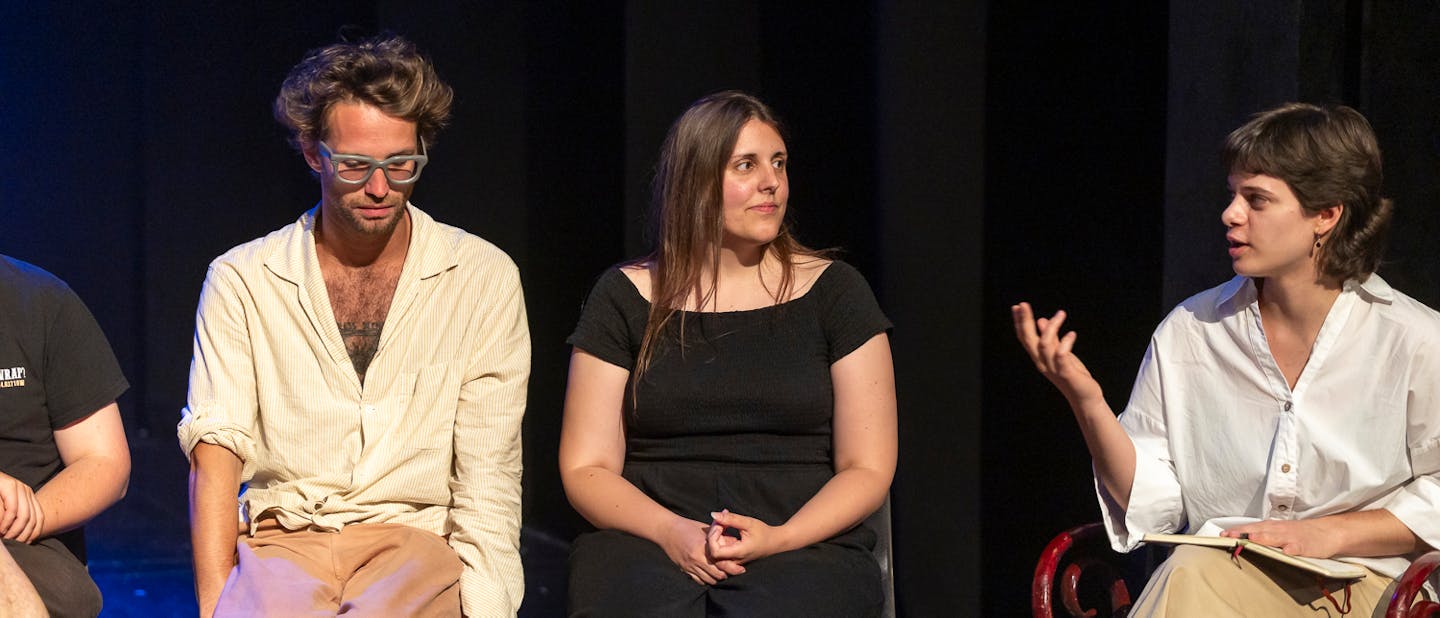
I would also like to think "out loud" about the word discussion itself, and consequently, about the content of these events. As long as discussions remain at the level of asking questions and receiving individual answers, it feels more like a short (or not so short) post-show interview rather than a genuine discussion. A discussion, in my view, implies an exchange of opinions, a dialogue that is nearly (or completely) equal, and above all, prompts that encourage participants to reflect, where the answers demand—or expect—a counter-response. A discussion, I believe, requires listening and responding—responding in the form of a definitive answer, a new prompt, a follow-up question... something that drives the conversation forward and sustains its momentum. It is perhaps this momentum that can draw more people into participating—including the listeners in the audience, who, in an optimistic scenario, would also become active participants. This brings to mind the physical layout of these discussions, which invariably sets up a stage and the "speakers" on one side, and the space for the listeners on the other. If I imagine a discussion being "de-hierarchised" in this sense, I could also imagine greater engagement from the participants (especially those who are otherwise just the "audience"). I don’t have a concrete solution for what this layout would look like (a circle, which is the first thing that comes to mind, doesn't seem very productive either, as it creates a strange dynamic of being observed while observing). Perhaps it isn't even the layout that would change things. To draw on my experience again, during the discussion for the production Ocean Sea (Ocean morje), the audience on the other side engaged quite effortlessly (at least according to my subjective impression), sharing comments, impressions, praise, and asking questions. I would love for post-show discussions to be true discussions, though this might mean their content focuses more on what is stimulating for the creators themselves. If that requires prior coordination with them and preparing in a way that allows them to highlight a few topics they find valuable, urgent, or simply interesting to debate, it might also be much more stimulating for the moderator. How realistically feasible this idea is, I don’t know, but that isn't really the point. The point is the broader question of how to establish a dialogue—above all, a high-quality, constructive, critical, engaging, active (etc.) dialogue that can meet many different expectations. And simultaneously, how to use the discussion format to create a space that not only allows for a free exchange of opinions but actively encourages and motivates it. Writing about expectations brings me back to the question of who these discussions are actually for, and what their purpose is. Are they primarily for the audience, more for the creators, or only for those who have just watched the performance? Are they about capturing immediate first thoughts after a show, or are they meant to be deeper conversations? Or perhaps, are they a form of archiving?
The mention of archiving makes me think of blog writing, specifically the Maribor Theatre Festival blog, which can serve as a kind of archive of festival events—depending, of course, on the nature and type of the post, as well as the event it covers. I find it fascinating to think of the post-show discussion itself as a method of documenting and archiving the festival. If we imagine these discussions being recorded or otherwise documented, making their content accessible to those who couldn't or didn't want to attend at that moment, someone might return to the discussion later. They could revisit the thoughts and questions raised, and by extension, reflect further on the production. Perhaps a documented discussion, functioning as archival material, could be the catalyst for ongoing conversation, or even for critical reflection on the performance, which I believe could benefit theatre criticism as a whole. Or perhaps we can view the post-show discussion as an invitation to criticism. In any case, returning to expectations (especially in light of my own preparations for this year's talks), I think discussions and criticism find themselves in a similar position: with both, we can ask ourselves what the essence is, what the purpose is, for whom, and why.
While writing the blog this year, I felt a need—likely due to the larger number of writers and particularly Kate Győrfi's diary-style entries—to establish a conversation, a dialogue within the blog format itself, among us writers. I don't know if that would mean responding directly to a specific post or searching for a shared "blogging" language (whatever that means), but perhaps it could provide a space where the conversation about and after the performances continues. A space where something said—or in this case, written—has an echo, in the sense of something returning, something given back. As long as it doesn't just become an echo of one's own words and thoughts, of course. If writing about performances after the performances echoes far enough, extending beyond online platforms and not just initiating but perhaps even demanding a conversation, then I would hope the format of the festival discussion becomes more firmly established. My train of thought moves even further, to a point where I want to completely contradict what I just wrote. The format of the discussion is already firmly established. Perhaps even too firmly, too "strictly" or too formally, too confined within agreed-upon frameworks, too within the horizons of expectation. What if we tried holding the discussion right in the theatre café? Or what if we were bold enough to do a quick chat on the way out of the auditorium? Could we combine discussions for multiple performances? Could these be conversations between the creators of two productions that are, on some level, similar (or completely different)?
*prevedeno z Gemini AI/translated with Gemini AI. This text was translated from Slovenian using AI tools solely to ensure international accessibility. As a festival that deeply values human creativity and authorship, we thank you for your understanding regarding any linguistic or contextual imperfections.