BB/16. On Bodies with the Body
12th day of the festival, June 19, 2026
I, David (UL AGRFT and Maska Ljubljana, a production of the Master’s Program in Theater Directing (UL AGRFT), dir. Gabrijel Lazić)
As this year’s Borštnik Festival draws to a close, I’d like to draw attention to a production that stands out in several respects within the festival’s student program. I, David is a play based on the true story of a family whose life is turned upside down by a single tragedy. In 1965, Janet and Ron Reimer had twins (Bruce and Brian), but during a circumcision procedure, Bruce’s penis was severely injured while he was still an infant. The damage was irreversible, and it was clear that Bruce would have to live without a penis. Following the advice of Dr. Money, Bruce’s testicles were removed; he was renamed Brenda (later changing his name to David) and raised as a girl under the premise that gender identity is social and learned. However, David never felt comfortable in this role; he expressed a strong sense of incongruence and struggled with his identity. When the truth about his birth was revealed to him as a teenager, he decided to return to his male gender and took the name David.
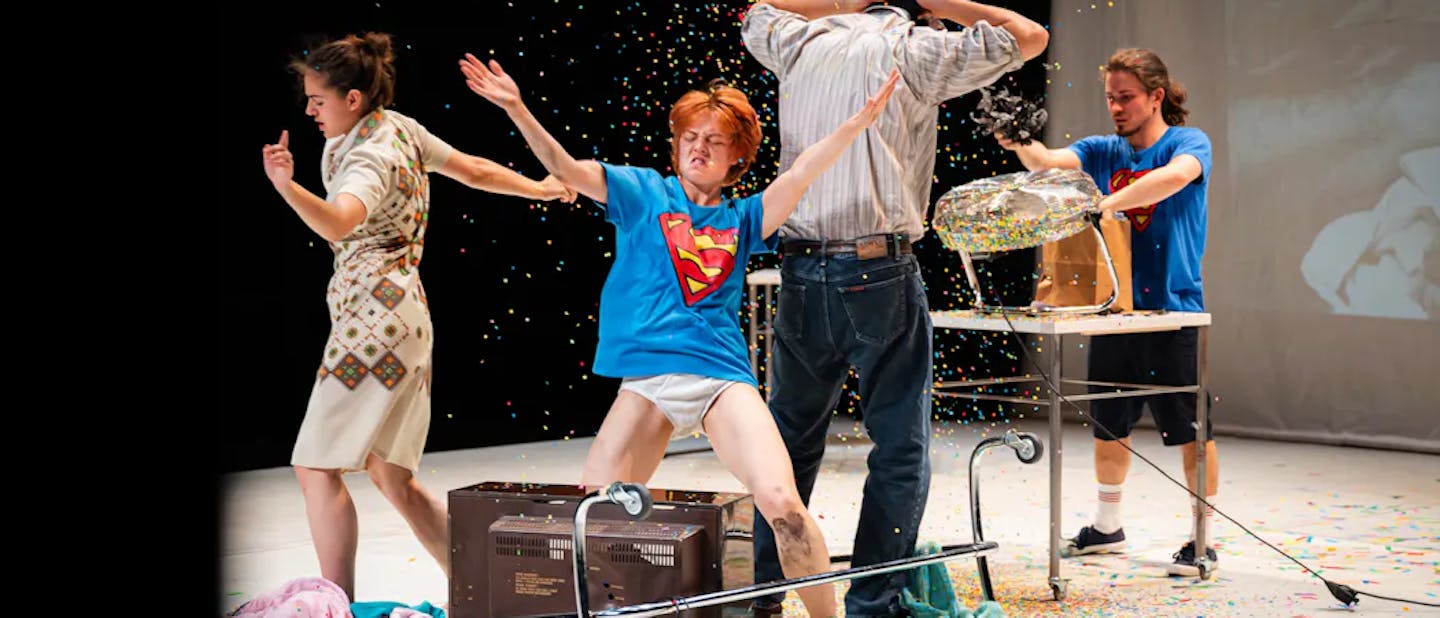
The script written for the production is complex and very dense (it contains many medical terms and explanatory passages), but Eneja Štemberger (Janet) and Muhamed Kulauzović (Ron) bravely tackle it. Their acting is mostly narrative. Luka Kotnik (Brian) doesn’t utter a single word in the play, yet his physical presence is so strong and so expressive that we can actually “hear” him very clearly. These three actors and the work done with them deserve special mention, as they were in their second year of acting studies on opening night. Kaja Petrovič (David) creates a character with a strong presence and a stubborn, intense gaze through which we sense immense frustration and a turbulent inner world.
The strongest aspect of the performance is the physical sequences (the soccer scene, the physical interaction between the twins wearing the same shirt…), which convey the theme of gender identity and the feelings associated with it more effectively than words. Kotnik remains completely silent, while Petrovič speaks only a few words until the intermission. This powerful choice carries a wealth of meaning. No one gives the twins a voice, so they express their will through facial expressions, gestures, and movements. Yet, thanks to their refined physical expression, the audience hears everything they have to say. In the final part of the performance, we hear David’s (Petrovič) voice, which narrates the rest of the story in an audio recording. It might be interesting to see how this part would unfold without the audio recording, without the story being concluded in words. The performance creates a sense of agonizing duration; there are many moments of silence charged with tension, and the creators could have maintained this even in the final part of the performance.
The set design shifts from a domestic setting (brilliantly evoked by nothing more than a rug, a table, and a television) to a sort of laboratory. With their clothes and furniture on the white dance floor, the family finds itself in a space for experimentation; the space also expands, and the distances between the characters grow larger. Live footage (of David’s body) is also used and projected onto a large screen on the back wall. This part caused some technical difficulties, which are not to be held against the production, but they did show that the use of this element is not essential. Other images projected onto the screen are more effective (photographs of genitals, an image of a happy family that creates a striking contrast with the spoken content…). The production also features excellent music that appropriately supports the action without drowning it out. With very limited resources, the production’s central theme is clearly conveyed and evident on all levels.
The binary understanding of gender is examined through a carefully chosen story that approaches complex gender issues via the universal context of family and parenthood. In this way, it also speaks to audiences who may not otherwise encounter these themes very often, inviting them to reflect on their own perceptions and expectations regarding gender. However, for individuals with more knowledge about gender identity, the play is somewhat less interesting thematically.
I, David is a high-quality student production that uses the body to address violence against the body.
With this post, I bid you farewell until the next Borštnik Festival! Thank you to the BB team and all our readers!
*prevedeno z DeepL AI/translated with DeepL AI. This text was translated from Slovenian using AI tools solely to ensure international accessibility. As a festival that deeply values human creativity and authorship, we thank you for your understanding regarding any linguistic or contextual imperfections.