BB/8. The Cry of an Exhausted Body
A Safe Place. A Journey to the Central Mediterranean, Emilia Romagna Teatro ERT / National Theater (IT)
Max, Mischa, and the Tet Offensive, Zagreb Youth Theater (HR)
Sonoma, La Veronal (ES), Opening Performance of the 61st Borštnikovo Srečanje Festival
In addition to its competition program, Borštnikovo Srečanje offers an important accompanying program each year that provides a platform for foreign productions. It is precisely these performances that often attract large audiences, as they provide exposure to diverse European theater practices. This year’s opening performance, Sonoma, was a true hit, with a full house and a standing ovation. In this post, I’ve compiled some observations, thoughts, and summaries of three performances from the festival’s accompanying program during the first week.
A Place of Safety. Journey to the Central Mediterranean is a production by the Italian theater company Emilia Romagna Teatro ERT, the Kepler-452 theater group, and we were able to see it at the Borštnik Festival on June 8, 2026, the first day of the festival. What stands out most about this production is the context in which it was created, as the theater artists traveled to the Mediterranean aboard the Sea-Watch rescue vessel to conduct field research on the world’s most dangerous migration routes. There, they met the rescue, organizational, and technical teams and witnessed the rescue of people from rubber boats. The performance features the director (who himself spent 10 days on the ship) and some crew members (a nurse, an electrician, etc.). Each of them reflects on their involvement in the mission, shares anecdotes related to their time on board and the rescues, and describes the emotions they experience while doing their work. What is most striking is the sheer number of people; in one of the rescue operations described, assistance had to be provided to five rubber boats carrying a total of about five hundred people—people who board these rubber boats every day in the hope of a better tomorrow, each with very different reasons for leaving (political, economic, personal …). Equally shocking, however, is European policy, which ignores this problem and systematically fails to support rescue efforts. People are thus left at the mercy—or lack thereof—of the Mediterranean Sea, whose depths are becoming a mass grave, while organizations that save lives at sea are often treated as criminal entities.
The play raises questions about migration and human rights and reveals “the truth about Europe, which is revealed precisely at its borders” (as stated in the play). The set design is effective, featuring parts of a ship, life jackets, and a lookout tower on stage, though it might benefit from a few more elements to build the atmosphere. The performers are very different from one another, but they seem a bit too scripted, so they don’t always come across as entirely authentic.
The performance avoids the melodrama of the stories and does not sensationalize accounts of rescue missions. Instead, it also questions the very production and presentation of such stories to a European audience. Nevertheless, at times the director falls into overly long and emotionally charged monologues. Above all, the performance treads the line between moralizing and being moralistic; it is most successful in its documentary-style approaches and content (one of the most powerful moments is the footage of people dancing on deck after the rescue).
The first half of the performance moves at a somewhat slower pace, but we can forgive this, at least in part; at one point, the director himself addresses this issue when he wonders what to do with all these words and stories. In doing so, he indicates that the slower pace of the first part is a conscious dramaturgical decision, intended to highlight the multitude of stories and words surrounding the theme of migration. Precisely for this reason, the question of what to do with all these stories becomes the most powerful moment of the performance: it no longer asks only about migration, but about a world that constantly records, describes, and comments on tragedies, yet still allows them to happen.
The next performance I saw was Max, Mischa, and the Tetovska Offensive by the Zagreb Youth Theater. It’s a completely different kind of theater—a story about growing up, change, and art. Nika has already written about this performance on the blog, so I’ll keep this post brief. The performance filled the stands of the Ondina Otta Klasinc Hall and enriched the accompanying program with its unique energy, excellent cast, set design, and musical score. What both performances have in common is their exploration of departures and migration, each within its own social context, social class, and geographical space.
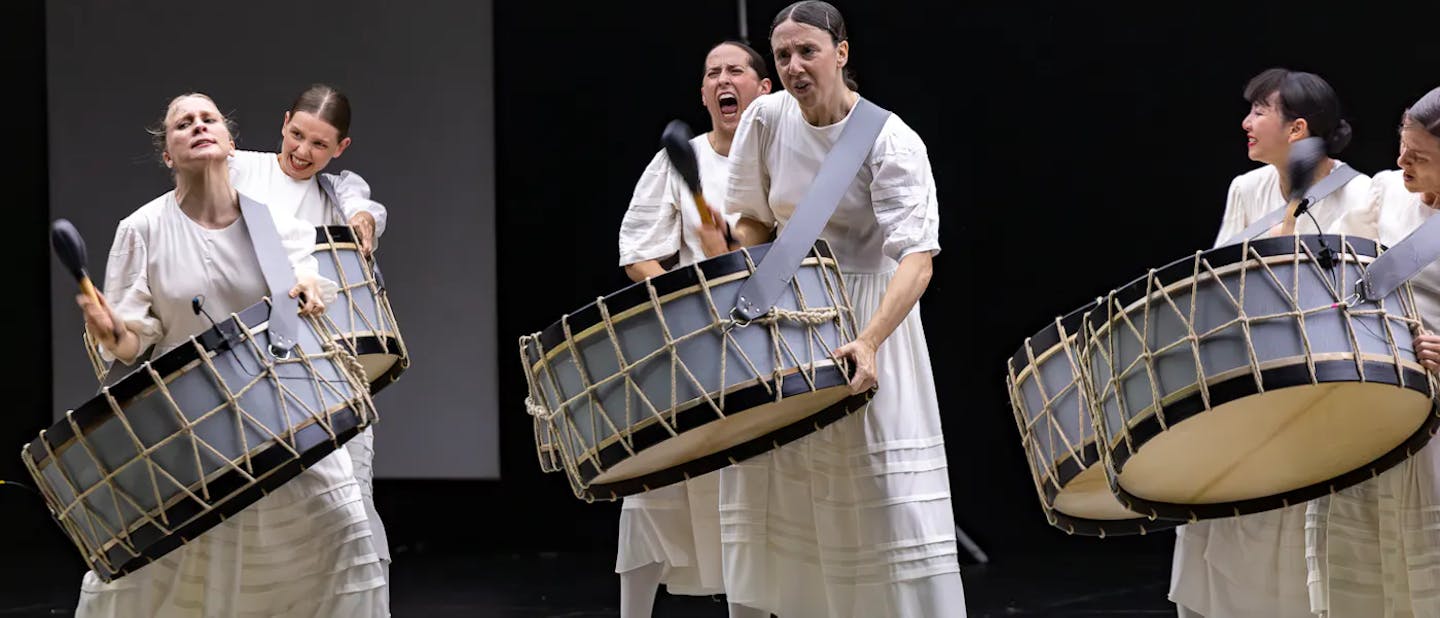
The opening night featured the performance Sonoma (La Veronal, Spain). A dance performance that transports the audience into dreamlike imagery, blending reality, dreamscapes, and fiction. The performance begins with a scream. On stage are dancers in costumes reminiscent of timeless folk attire (uniform dresses with scarves and crinolines). The dresses reach all the way to the floor, so that their legs are hidden from view, and their movements resemble floating. When they sit down and speak, the performance begins with prayers or ritual chants of gratitude (blessed are those …). Afterward, the dance begins—a rhythmic, distinctly physical, group-oriented, and meticulously choreographed performance. A sense of ritual and the solidarity of the women is present throughout. Birth and death. “Life is short, art is long.” The performance features many cries that express the strain on the body. The dancers lead us into darkness, into a storm, and through an escalation of rhythms. We witness a unique sense of ceremony, offerings, prayers, and ritual. The stage is illuminated by large panels that the dancers move across the stage, while the one above them descends toward them and then rises back into the air. From a dark atmosphere filled with dark spirits, death, and a special kind of magic, the performance shifts to branches, flowers, and spring. The thunder gives way to a forest; the dancers become young girls, fairies playing in a clearing.
In the end, all the power and energy are released through drumming, shouts, and chants that speak to the power of women throughout human history. *Sonoma* has a hypnotic effect; it is visually intense and brings surreal images—drawn from folklore and religion—to the stage. It bridges the past, present, and future. From their solitary inner cries, the women create a community and, through it, a collective cry that completely and utterly envelops the stage, the auditorium, and the bodies of the audience.
These performances differ greatly from one another in both their approaches and themes, yet they are all confident in their expressiveness and effective in their own unique ways. Once again this year, the accompanying program during the first week of the Borštnik Festival left no one indifferent.
*prevedeno z DeepL AI/translated with DeepL AI. This text was translated from Slovenian using AI tools solely to ensure international accessibility. As a festival that deeply values human creativity and authorship, we thank you for your understanding regarding any linguistic or contextual imperfections.