BB/14. [the dystopia we’re living in]
It’s hard to start writing about a topic like capitalism—more specifically, our concrete contemporary experience of Western post-capitalist society—without repeating what has already been said countless times. Without repeating truths that, due to their apparent inevitability, already seem like clichés. It is difficult to put into words what most people recognize as a problem anyway; it seems so utterly hopeless that we have almost resigned ourselves to it, which is precisely why it is so imperative that this be addressed by the only medium that manages, at least now and then, to escape this destructive mechanism—art. Three directors of the younger generation, however, in the productions included in this year’s competition program, each in their own unique artistic voice, grapple with the themes of (post)capitalism—ranging from its proto-forms to dystopian and speculative predictions of the possible direction in which we are all hurtling together.
Ivan Cankar, Varja Hrvatin, Bor Ravbar: And Many Others...
dir. Bor Ravbar, SLG Celje in co-production with the Prešeren Theater Kranj
June 14, 2026
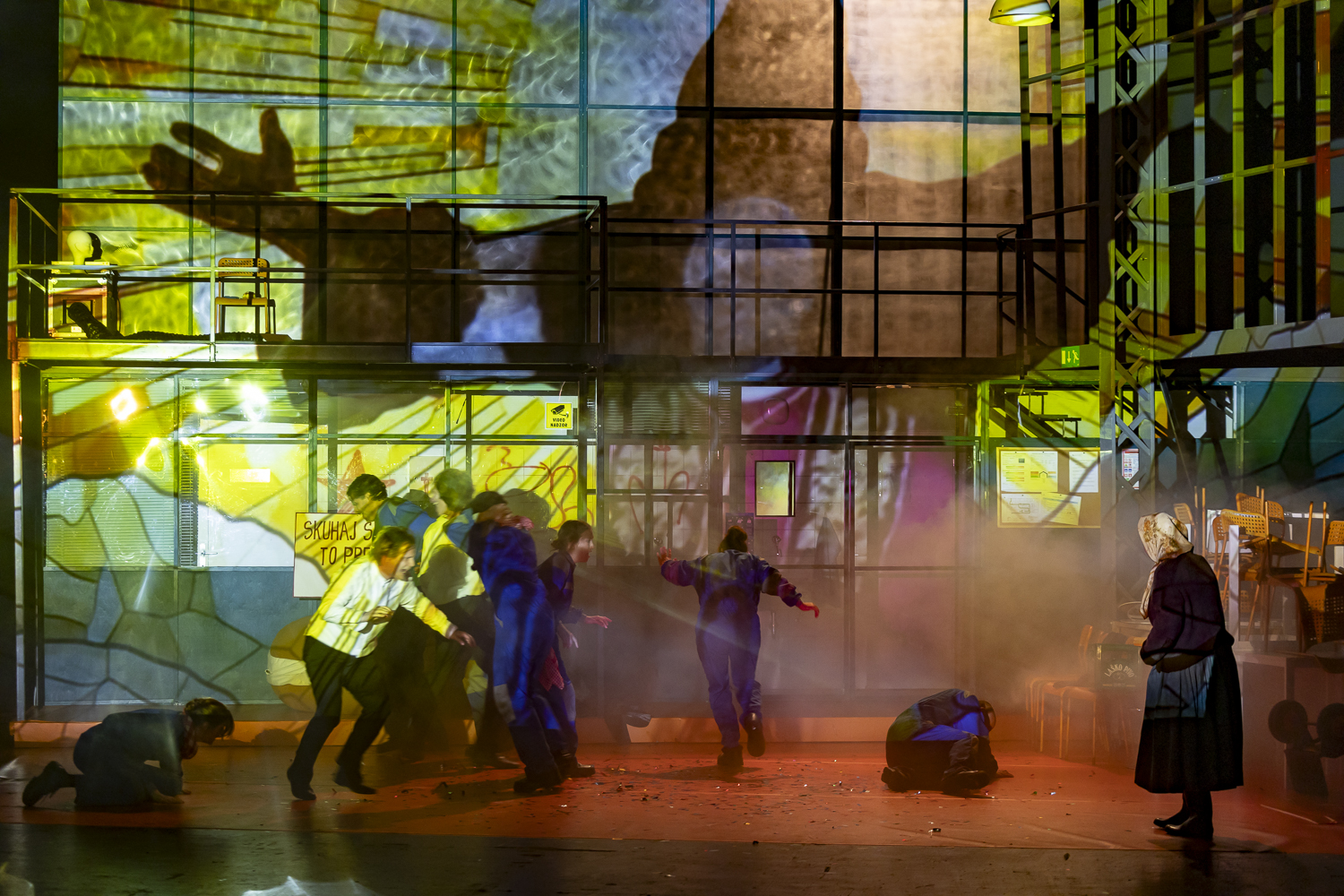
The play And Many Others... draws primarily on Cankar’s prose works, most notably the short story He Denied His Mother, which has left an indelible mark on the Slovenian collective memory due to the archetype of the Cankarian mother established within it. However, rather than offering an individual moral judgment on Jože’s betrayal of his mother, the story reveals a broader discourse on social shame—a theme that is, in fact, the central thread running through much of Cankar’s prose. The authors of the dramatization, Bor Ravbar and Varja Hrvatin, seek motifs of poverty in Cankar as their creative starting point, and then strive to bring the Cankarian archetype into the present. In the contemporary economic and political world, in which the middle class is slowly disappearing, and at the same time definitions of the working class are often unclear, attitudes toward poverty, shame regarding one’s own social position, and the ideal of education as the sole hope for social mobility are not so far removed from the conditions of early capitalism in which Cankar lived—except that today we encounter different forms of precariousness and labor.
The production, rooted in historical realism and closely following Cankar’s short story, transitions into an increasingly dynamic form that, through its play with formats such as a television quiz show or a fashion show, escalates into dystopian chaos. The constant elements are the characters of Jože, Cankar’s alter ego from the short story (Luka Bokšan), his mother (Vesna Pernarčič), and the apostle (Aljoša Ternovšek)—initially serving as moral authorities, but later as guides to the unfolding events, introducing the audience to various theoretical perspectives on the working class. The remaining characters form a sort of collective—representatives of Cankar’s vision of somewhat different strata of Slovenian society—who, between the lines, all harbor a certain degree of unease toward their own class, which are actualized in the contemporary mass of nameless workers who appear in a sort of choral function, as they create a vocal backdrop that recreates the rhythm of industrial machines or the monotonous, soulless rhythm of everyday life. And many others... thus debunks one of the Slovenian myths by showing that there is something in Cankar’s world closer to us than we might care to admit—or as it was addressed in the elementary school classroom when we read from our textbooks the story of Jože, who disowned his mother because of her peasant attire— yet we never asked ourselves where we, too, feel such shame.
![≈ [Almost Equal To]](https://www.datocms-assets.com/121363/1781588504-6a7a4853.jpg)
Jonas Hassen Khemiri: ≈ [Aloughly Equal To]
dir. Maša Pelko, SNG Drama Maribor
June 15, 2026
This comic drama by a contemporary Swedish author bears the title of a mathematical symbol that signifies the meaning of an approximate equation; the play plays with the structure of an equation in which capital stands on one side and the weight of human life on the other. By portraying perfectly ordinary contemporary individuals, it subtly illustrates how cruelly the mechanisms of modern capitalism—which have become deeply ingrained in the individual’s personal mindset—control our lives. Both the text and the production draw attention to an assumption that at first seems drastic or even ridiculous, but is actually not so far from reality: what ultimate benefit a particular experience (say, a theater performance) brings us, and whether it is worth it in relation to our investment (say, the ticket price)—whether the experience is ultimately worth it.
Director Maša Pelko condenses the authors’ multifaceted exploration of the contemporary struggle against capitalist logic into a cast of just five actors: Blaž Dolenc, Petja Labović, Ana Urbanc, Minca Lorenci, and Kristijan Ostanek. What remains are poignantly ordinary characters who, precisely because of their subtlety, cut deeply—especially since the intimate proximity of the Small Stage makes them seem truly close to us. At the same time, the directorial style is playful and ingeniously shifts between realistic acting, performative outbursts, and narrative interludes, allowing the production to skillfully navigate between existential dread and relief-bringing laughter. What unfolds is a precise depiction of the silent capitalist machine that grinds down everything in its path—especially what is vulnerable and human within us—and cannot be stopped; there is never a break, not even in the performance itself, since the intermission is staged, and the audience does not leave the theater.
Rrose Sélavy: Oil
dir. Jan Krmelj, Mini teater
June 19, 2026
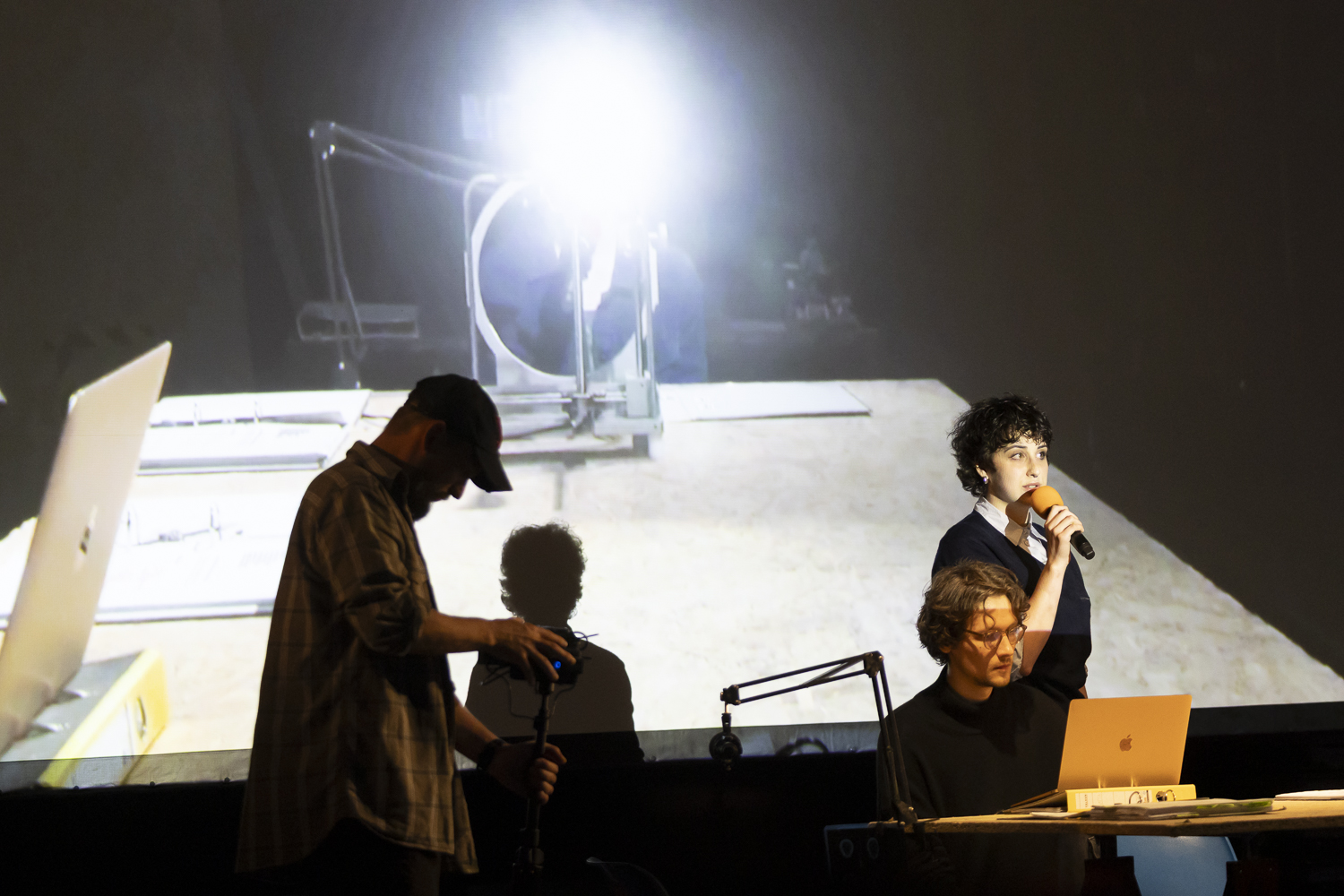
The original production Oil, co-created by director Jan Krmelj, dramaturg Jernej Potočan, and the cast—Jernej Gašperin, Diana Kolenc, Mojka Končar, Gašper Lovrec, Lucija Ostan Vejrup, and Filip Mramor, approaches the issue of capitalism from the perspective of ecology and artistic activism. To explore the contemporary world, it adopts a format that blurs the lines between fiction and fact, resonating with the dystopian feel of the reality we live in. It follows the members of the notorious art collective R. MUTT—artists and activists who created a notorious podcast between 2019 and 2023, only to vanish, presumably without a trace; the story is further contextualized by the “Transparency” exhibition, where they offered visitors a glimpse into their entire lives—or rather, the data available about them. Through this, data capitalism—perhaps one of the most terrifying modern manifestations of capitalist exploitation of human beings—is established as one of the central themes of the performance.
Within its fragmentary structure, it combines documentary data, personal stories—whether true or not—ready-made materials, video interventions, and a sound track created in real time. The action on stage is layered, multiplied, reframes, and magnified via lense of a camera—a signature directorial style of Jan Krmelj—while the camera’s gaze also evokes the paranoia of a surveillance society generated by the digital age, and the associated desire for withdrawal, disappearance, and untraceability—the latter of which the R. MUTT collective has presumably succeeded in achieving. Oil, that dark and viscous substance formed from once-living beings, establishes itself as the link between prehistory, the present, and the future—which is still only a premonition—a memory of the species that once ruled the earth, a symptom of the destructive mechanisms of the modern era, and a reminder of the time to come, which no one can stop.
Manca Tea Devetak
*prevedeno z DeepL AI/translated with DeepL AI. This text was translated from Slovenian using AI tools solely to ensure international accessibility. As a festival that deeply values human creativity and authorship, we thank you for your understanding regarding any linguistic or contextual imperfections.