BB/3. How long you must be away before it’s too late to return?
Original title: Max, Mischa, and the Tet Offensive
Zagreb Youth Theater (HR)
Director: Ivica Buljan
Adaptation and dramaturgy: Vid Hribar
The Zagreb Youth Theater’s production Max, Misha, and the Tet Offensive, directed by Ivica Buljan and based on the novel by Johan Harstad, has made its way to Maribor.
The play is a chronicle depicting the life and coming-of-age of Max Hansen, (Ugo Korani). We meet him at age 12, when he spends his days with his peers playing war games (mostly about Vietnam) and is fascinated by Coppola’s film *Apocalypse Now*. A year later, his life is turned upside down when he moves with his family from a small Norwegian town to Long Island, in the state of New York. Thus, with great pain, he leaves behind his school, his friends, Norway, his language, his culture, and himself. He even compares himself to a pineapple that was forced to be sent or migrated far away. At night, he dreams of how the great America will keep growing and growing and will eventually reach all the way to Europe, allowing him to return home to Norway. Over time, he always adapts to the new reality, the new place, and the new people. While his parents begin to drift apart and live the misery of the American dream, Max finds support in his friend, later the actor Mordecai (Ivan Jurković), in his love for the painter Misha (Hrvojka Begović), and in the support of his uncle Ova/Owen (Rakan Rushaidat).
In this 3.5-hour performance, the dramaturgy (by Vid Hribar) weaves together three strands of Max’s existence, which are so intertwined that they metaphorically form a ball of wool (from which Max’s mother knits a sweater) or the very fabric of life itself. Running uncompromisingly through the main thread are themes and questions of human existence, war, migration, and growing up, which develop throughout the performance into a thread of art and theater, and ultimately immerse themselves in the exploration of love, community, and belonging. Humans were never meant to be solitary animals capable of surviving self-sufficiently in the wilderness. Quite the opposite. Humans constantly need connections with others and yearn for community and love. And this is precisely what Max is seeking: his people, with whom he could share the pain of growing up and the deep wound of the world. The narrative, which thus intertwines multiple time periods, geographical spaces, and cultures, is further shaped by the costumes (Ana Savić Gecan). They establish diversity and shifts between Europe and America, between glamour and misery, between inner struggle and the outside world, and they shape Max’s memory. The musical pieces (Darko Rundek), which are occasionally performed live, add another layer to the storytelling, emphasizing feelings of nostalgia, loss, and longing for home.
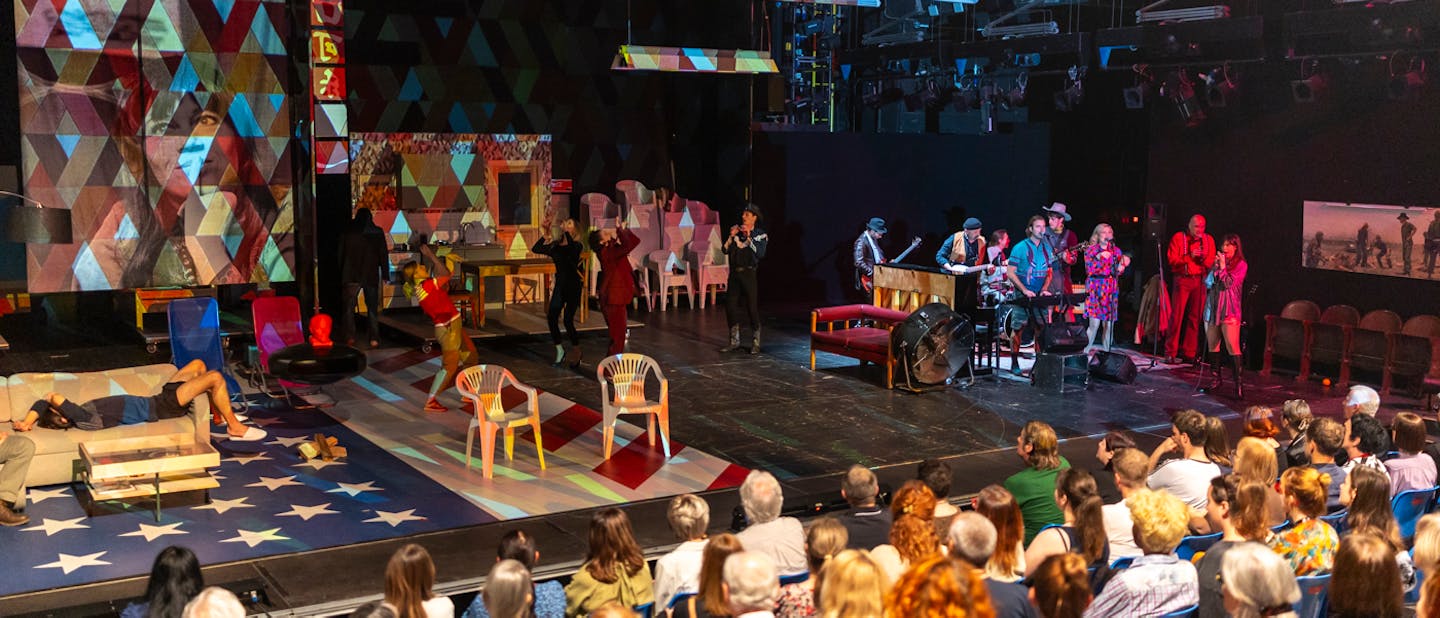
The open set design (Aleksandar Denić), with its arrangement of various moving platforms, spaces, and rooms, creates a fragmented landscape of memories. In doing so, it reinforces the play’s central themes—migration, travel, and the search for a home that can never be found in a single place. Home is something very elusive; yet one could say it is more a state of mind than a physical or geographical marker. It is precisely this fragmentary dramaturgy and set design that allow director Ivica Buljan to establish the performance’s incredibly rapid dynamics and to stitch the scenes together with millimeter precision. For while one scene is still unfolding, the next is already quietly beginning, giving us the feeling that perhaps we are not watching a theater performance after all, but a film.
In form, the performance is divided into two parts. If the first part is a kind of construction of the world, of opportunity, of the American dream, of growing up, and of making sense of things, the second part (i.e., after the intermission) is one of collapse. An apocalypse. In style, setting, and staging, it is a kind of diametric opposite to the first part. Thus, the actors sit on immovable plastic chairs as a collective traumatized by the world, by pressure, by all possible wars. Tired and disillusioned with life. Hand in hand with this, Max’s story also enters a new era. A life that is thoroughly shaken in every possible direction. The 16-member cast, in excellent physical condition, masterfully establishes a sense of collective performance through both major and minimalist roles. As a result, the audience gets the feeling that every single element of the theatrical production supports one another, that no one or nothing is rushing ahead, yet together they propel the narrative forward.
Another fascinating scene is the one in which Max’s mother, Beate (Lucija Šerbedžija), uses an orange to explain to her son the fragility of life and theater. If you throw an orange onto the stage during a performance, it can distract the actors, interrupt the show, and shatter the illusion. Yet this is precisely the essence of theater. Liveliness. Existence in the here and now. Exposed to chance, external interference, and error. And that is exactly what our lives are like. Fragile. Our relationships. Fragile. Our dreams. Fragile. Our illusory reality. Fragile. Every single aspect of life can be interrupted by history, migration, war, loss, or chance. Everything is so very fragile. Oranges, which are a well-known symbol in film—for example, in The Godfather—represent a foreshadowing of death, fate, and vulnerability. Fragility. And if we draw another thread here regarding the interconnectedness of life: Coppola (director of The Godfather) is also the director of Max’s favorite film, Apocalypse Now, which, among other things, awakens his desire to create.
In the opening scene, which resembles a news interview or talk show, Max talks about returning home, about searching for a place to call home—a place he himself found in the theater. And that is why he believes the theater is a home for people without a home. No matter where in the world you are. No matter what you do or who you are outside the theater. When you can’t find your place in the world, you can simply build it yourself. And it is precisely in this that the play Max, Misha, and the Tattoo Offensive shines at its best. Not only does it build, but for 3.5 hours it builds and tears down worlds, telling stories across different times and spaces—and on multiple levels. It skillfully weaves together current existential and political themes, raising endless questions that haunt the audience long into the night after the performance.
Nika Šoštarič
My distance from SNG Maribor at the time of writing: 128 km (in Ljubljana, where I feel more at home than in my hometown).
*prevedeno z DeepL AI/translated with DeepL AI. This text was translated from Slovenian using AI tools solely to ensure international accessibility. As a festival that deeply values human creativity and authorship, we thank you for your understanding regarding any linguistic or contextual imperfections.