BB/6. Madness as a Diagnosis of the World
William Shakespeare: King Lear
SNG Drama Ljubljana
Director and Dramaturg: Jernej Lorenci
Shakespeare’s King Lear is one of those plays that every era interprets anew. Its exceptional nature lies not merely in the psychological complexity of its characters or the monumentality of its tragic structure, but above all in the fact that it condenses certain fundamental questions of political and social life: questions of power, legitimacy, truth, community, and violence. If Hamlet has often been understood as a drama of the modern subject, King Lear is a drama of a world losing its shape. Faced with contemporary social and political upheavals, it therefore seems that we view Shakespeare’s tragedies not as stories from the past, but as a disturbingly relevant diagnosis of the present.
Despite the 400-year gap between the writing of the text and Jernej Lorenci’s production, the fundamental themes remain surprisingly relevant. A wolf—or a man—may change his coat, but never his nature. King Lear’s world is one of violence, arrogance, and revenge, in which it is impossible to draw a stable line between the private and the political. In this sense, Lear foreshadows not only the collapse of the family order but also the broader disintegration of the social fabric. His famous madness begins precisely at the moment he loses power over the kingdom and his family. But the question raised by Lorenci’s production is: where does this madness actually stem from—from Lear’s character, his greed and arrogance, or is it his surroundings that push him into madness?
The production does not resolve this ambivalence but materializes it through the language of the stage. Andraž Polič’s musical score sets the atmosphere for the entire performance, with the sound spectrum ranging from birdsong to the marching of military troops and popular musical references such as “Everybody Loves Somebody.” This heterogeneity of sound does not function as an illustration, but rather as a fragmentation of a world in which there is no longer a unified order of meaning.
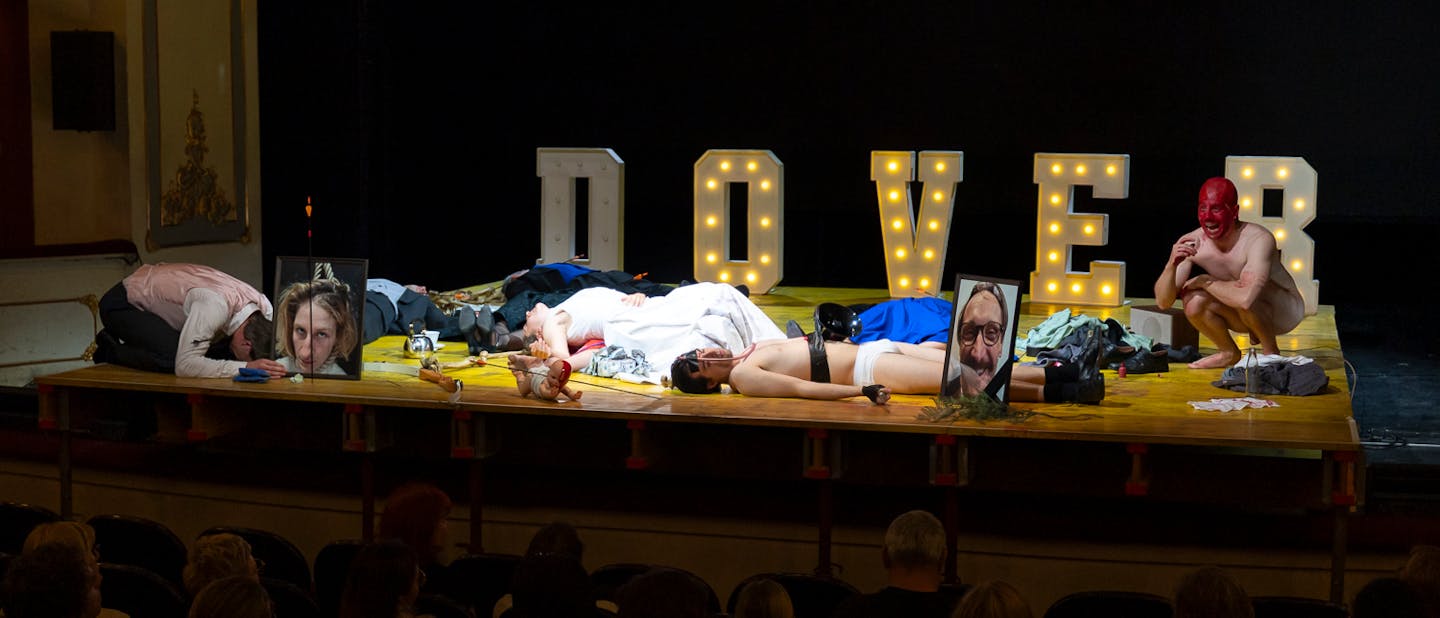
Branko Hojnik’s set design is minimalist and, at the same time, strikingly raw: a large yellow floor, a microphone, and a few technical props create a space that does not attempt to represent a kingdom, but rather its emptiness. This emptiness is not neutral, but violent. It is a space in which authority is reduced to mere presence and speech to mere performativity, which in this context becomes a particularly significant layer of the performance. A large part of the play is thus based on the body and movement (Gregor Luštek). At the beginning of the performance, for example, a rule of the world is established: before the king, everyone humbly moves on their knees. However, the physical image of the performance is further enhanced by elements of body painting, which serves as a disguise for the characters, yet thereby emphasizes raw human nature all the more. The scenes in which actors Jure Henigman and Marko Mandić are wrapped in plastic wrap are also fascinating. From head to toe. Empty capitalist plastic thus functions as a modern-day pillory, serving as a violent ritual of dehumanization.
Nevertheless, the performance we are watching is distinctly dramatic. One could say that all the elements of the production are arranged in such a way as to bring the play to the very forefront and unfold it. Janez Škof, who plays the title role in the first act with his back turned to the audience, uses the manipulation of his voice, his weary body, and his mind to gradually escalate the king’s madness to the very brink of the abyss throughout the entire performance. Ivana Percan Kodarin, as Cordelia and the Fool, stands right alongside Škof with a subtle and equally mad performance. There is, in fact, a tradition of interpretations that links the two characters as two sides of the same truth. When Cordelia disappears, the Fool appears, with both acting as Lear’s most sincere spokespeople of truth. Timon Šturbej and Domen Novak also play a striking counterpoint; in the roles of the brothers Edgar and Edmund, they create an additional divide between malice and innocence, which cannot exist without one another.
Tamara Avguštin as Goneril and Mina Švajger as Regan, with their powerful stage presence, embody ruthlessness and political opportunism, yet they can also be understood as products of the system created by Lear himself. Their cruelty does not arise in a vacuum, but in an environment where relationships are, from the very beginning, subject to the logic of power. In this sense, they are not merely wicked daughters, but heirs to the political order they seek to take over. Beside them stands Oswald, one of the drama’s most intriguing supporting characters, a figure of a servant whom interpretations often push to the margins of the action, yet in this production he exists as a significant symptom of the world. Peter Podgoršek thus constructs a character who is not a great villain of Shakespearean proportions, but something far more mundane and therefore perhaps even more disturbing: a man who unhesitatingly adapts to the prevailing circumstances. On the other hand, Duke Gorazd Logar as Albany represents a rare opportunity for moral awakening, and it is precisely here that one of the tragedy’s most pessimistic dimensions is revealed: individual voices of reason exist, but they no longer have the power to halt the world’s collapse.
One of the play’s key dramatic threads is the gradual disintegration of language. At the beginning, the performance is still distinctly verbal, saturated with speech, arguments, and statements. But as the performance unfolds, speech is gradually reduced. Language disintegrates, relationships disintegrate, the kingdom disintegrates, the world disintegrates. This process is not merely thematic but structural: the audience witnesses the disintegration of communication itself. In this sense, madness is no longer merely the state of an individual, but the effect of a world that is losing its ability to articulate itself. Perhaps this is why the fundamental question of the production is whether King Lear is a story about the disintegration of an individual or about the brutal human force that simultaneously causes this disintegration and attempts to suppress it. Lear’s madness is not merely a consequence of the loss of power, but also the result of a system in which power is always already violence.
At the end of King Lear, there is no salvation and no just punishment. There is no clear moral judgment that would restore the order of the world. It is precisely in this that its tragic radicalism is revealed. The visionary dimension of Lear lies in the fact that it foretells the repetition of history, in which the collapse of order does not lead to new stability, but to new forms of violence.
Number of hours spent watching the show: 5.5
Number of coffees during intermissions: 1
Number of coffees throughout the day: 5
Nika Šoštarič
*prevedeno z DeepL AI/translated with DeepL AI. This text was translated from Slovenian using AI tools solely to ensure international accessibility. As a festival that deeply values human creativity and authorship, we thank you for your understanding regarding any linguistic or contextual imperfections.