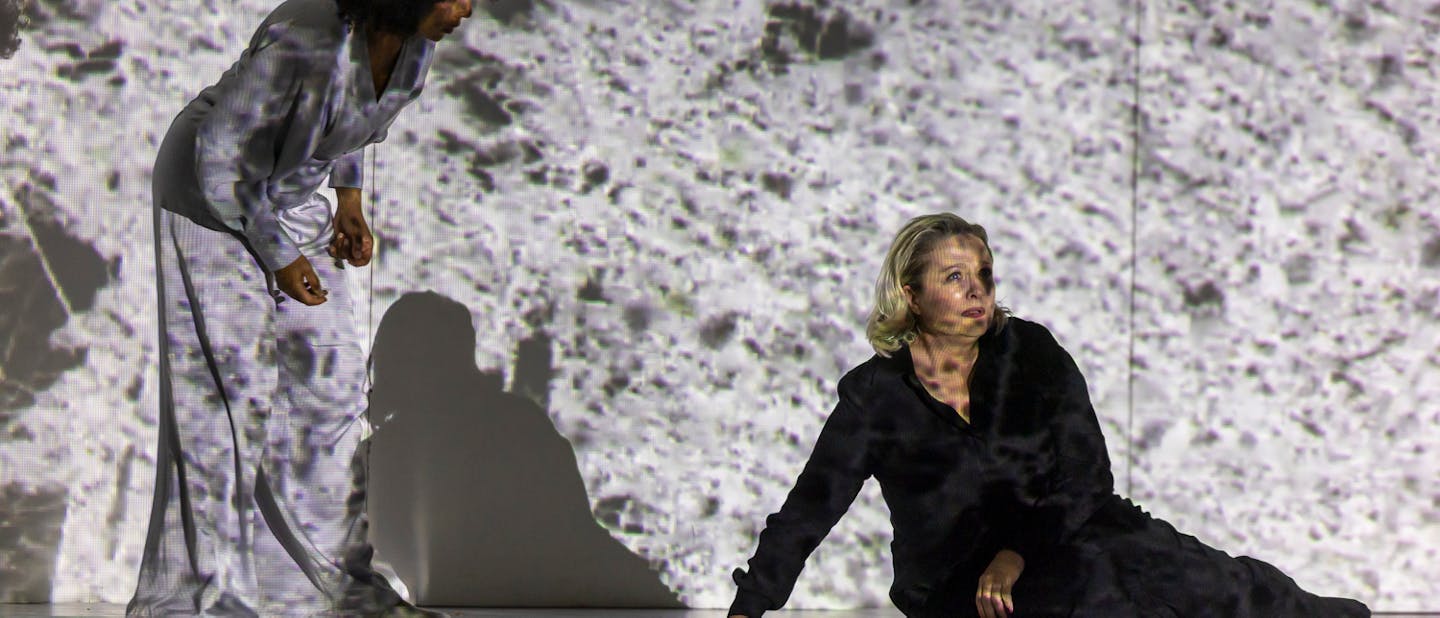
June 17th – Guest Journal: Kata Győrfi (Day 9)
Surprisingly, yesterday was the day when I took the most notes during the performances. I do not know whether it was because I am getting tired and was afraid that if I did not write things down the thoughts would disappear, or because I am only now getting into the rhythm of it, and I had so many thoughts at once that I simply had to write them down. If I look only at yesterday's notes, if I compare only the notes I took on the two performances, it is already very telling.
I will begin with the second performance, because regarding the first one I have not yet decided whether I want to be honest, whether I do not want to deal with it at all, or whether, out of respect for the actors, I should reflect at least a little on what we saw. But I will decide that after lunch. Until then:
I first encountered the name Robert Icke years ago, though I no longer remember in what context. Perhaps some post-Covid conversation in a pub. What I do know is that at some point his play The Doctor ended up in my hands, and I remember reading it with pleasure, but then I completely forgot about it. It did not even occur to me yesterday when I glanced at the ticket before the performance.
I had a feeling of déjà vu, but I assumed I was simply tired. Apparently déjà vu is nothing mystical; it is just a neurological fatigue, where what you perceive is processed slightly later by your tired brain, and that delay of a few millionths of a second is enough to transform the perception into a memory. So it feels as if you have already been there, as if you have already seen it. For me it mostly feels as if I had already dreamed it. And that was exactly how I felt last night. The rapid and frequent shifts between complete darkness and harsh hospital-white lighting certainly helped make my eyes dazzle. In fact, my entire existence seemed to dazzle (laughs out loud). It seemed almost inconceivable that this was not déjà vu, but that I might actually have read it before.
Then there were two moments that made the familiarity suspicious, moments when I felt: I have been here before. Interestingly, both revolved around identity. The first was a question Ruth (Nataša Barbara Gračner) perhaps asks roughly one-third into the play: whether we should define someone as Jewish or not according to the Nazi, antisemitic concept of Jewishness.
The second occurs in Sami's (Timon Šturbej) monologue, which responds to Ruth's hot-seat confession. She strongly maintains that she—and perhaps identity in general—is not defined by belonging to a group. Yet she then confides to the people in the ring that Sami, her friend, changed sexual identity, and that she is proud of them. Ruth publicly outs Sami. Sami confronts Ruth for exposing them, for placing them inside a box, for assigning them to a group, and for doing so only because this supposedly sensitive gesture served Ruth herself.
When these two passages appeared—passages I was now rereading also in English on the subtitles—I suddenly saw flashes of my old living room, looking up from my Kindle and thinking about these exact ideas. I do not know whether other people experience reading this way. Perhaps everyone else remembers everything they read: authors, titles, plots, and so on. This is about as much as I can manage—that at least afterwards I can reconstruct the memory.
I wrote down two things about this performance, things I would rather think about than throw myself into the obvious political, rhetorical, identity-forming epistemological debate concerning language, what we owe language, how language is historical, political, and many other things besides. It is a Pandora's box, and I am not sure I still have the capacity to open it.
Instead, I would like to leave here a brief thought by Austin, a twentieth-century analytic philosopher of language, who argued through speech-act theory that language is performative, and that in order to apologize it is entirely sufficient simply to say: I am sorry.
So the first thing I finally write down for myself, on the eighth day of the festival, is the Slovenian word tišina. Until this morning I was completely convinced that this word also existed in Romanian, carrying exactly the same meaning as it does in Slovenian, Serbian, and Croatian. Because when I first heard it in the performances, I immediately understood what it meant. And this morning I looked it up because I wanted to write that we have at least one word in common, and such a wonderfully poetic common word at that. But according to the internet, no, the Romanian word tișină does not exist. Though I will still ask my friends about it. Until then, let us remain together in the delusion that tišina is tișină, and that both mean silence.
The second thing is a sentence from the end of the performance, one that resonates with my June 12 entry. And I have decided that this will be the sentence that, for the rest of my life, will immediately make me think of Robert Icke, this play, and this production: “Hospitals should be as beautiful as churches.”