June 13th – Guest Journal: Kata Győrfi (Day 5)
Somewhere in an interview, László Krasznahorkai says that he writes one and the same novel, and yesterday evening, on my way to the hotel after the impressive festival opening event, I caught myself having exactly the same first thoughts about Spanish choreographer Marcos Morau’s performance as I had after seeing the first production by Hungarian choreographer Csaba Horváth. And I will not be Krasznahorkai – how could I be? Who even writes something like that? – I will not write the same thing I wrote more than ten years ago, only about a certain fundamental experience, one that I spent months researching after that experiance. The two aesthetics do not resemble each other at all, the theme, music, set design, concept are completely different, but the experience is frighteningly similar.
And I am writing it down anyway because these experiences of aesthetic catharsis are also like falling in love: none of them are the same, and if you live your life truthfully and reflectively, then you know it is impossible for them to be the same, and longing for that first experience of falling in love is simply a waste of time. Because with every falling in love, it is primarily you who changes, develops, gains experience, and you can never again be the same as if you had not experienced what you experienced. And because of this – and this is why I am writing it down – the second or third or fourth falling in love is no less magical. On the contrary, it sweeps you off your feet with the overwhelming force of surprise: “after all this, I can still feel like this.” I have seen more performances in my life than the number of times I have been in love, so you can imagine the size of the euphoria.
My fundamental experience, then, is that what happens on stage also happens to me. I mean in my body. The only problem is that it is very difficult to write about this without using concepts from the Cartesian dualism that what I experienced is, in fact, radically opposing. According to Cartesian dualism, I have a body and a mind as separate things, and experience unfolds linearly and in time, so that first my body experiences something and then my mind “processes” it. In the middle of the twentieth century, Merleau-Ponty critically introduced the idea that the body is already in the world, and cannot be so easily separated from the mind in the process of experience. That the body is a corps vécu. And that when I watch La Veronal’s performance, my lived body, within an aesthetic simulation such as the experience of watching theatre, experiences with heightened intensity that which is there to be experienced, namely the performance itself. So every movement of the performance is also my movement.
Alongside this there is the neurological mirror-neuron theory, according to which, briefly, when someone makes a movement in front of me – and there is no shortage of such movements in Sonoma – a neural network is activated that somehow simulates the empathy of me having performed the movement myself. From this grew the concept of embodied cognition, with which Merleau-Ponty also ends up working with.
The music of the performance predisposes me toward a state of openness, it is astonishingly sensitive, it does not allow me to sink back into the chair, and as after a good film, I would listen to it again and again so that it could carry me once more through the performance. Juan Cristóbal Saavedra’s compositions embrace the other elements of the performance in such a way that at times I have the impression that the music is dramaturgically responsible for the production, a responsibility that it fulfils boldly, daringly, often recklessly. The choreography seems to exist in a responsive, dialogical relationship with it: a shift happens just slightly earlier than I could predict; a theme enters with the sound of a baby crying in such a way that I only connect it afterwards; it holds the bpm in a way that sustains the entire performance, and my heartbeat within. And the dramaturgy of these responses, timings, rhythms and shifts creates the illusion that I am not watching this performance, but living it there and then. For me, music is anyway the art form that is most deeply temporal, and I mean that in exactly the opposite way from what you might think: I forget time because – unlike literature, for example – it abolishes it for me.
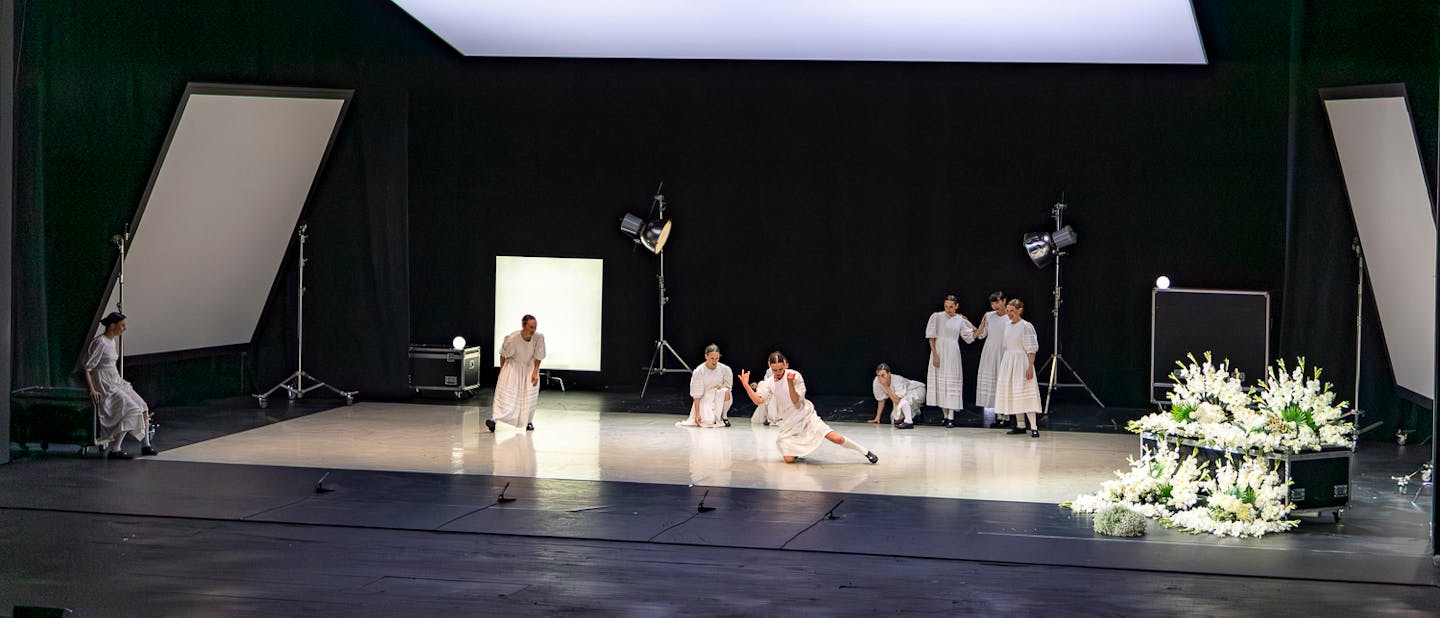
The set designers responsible for the visual world (Bernat Jansà, David Pascual), the costume designer (Silvia Delagneau), and the hat, mask and puppet designers (Nina Pawlowsky, Juan Serrano, Martí Doy) create that complex world in which I am at once terrified, surreal, horrific, yet at the same time soft, fragrant, familiar, and what alternates inside me beyond any possibility of tracking is: we will not survive this – we will survive this.
The dancers and the choreography operate through the power of community, the power of a movement performed together, the power of exact repetition, which we know from our ritual experiences to have a hypnotic effect. They hypnotically remind us of how similar we are; if I dare write it: they remind us that we are one. And what is hypnosis if not a state in which we can switch off everyday fussing, quotidian distraction, and experience life itself?
I took one photograph during the performance, at the moment when they celebrate with absurdly large and beautiful flower crowns, and I did so mostly because of the subtitle, a sentence I heard in an elongated choral piece: art lasts, but life is short.