June 11th – Guest Journal: Kata Győrfi (Day 3)
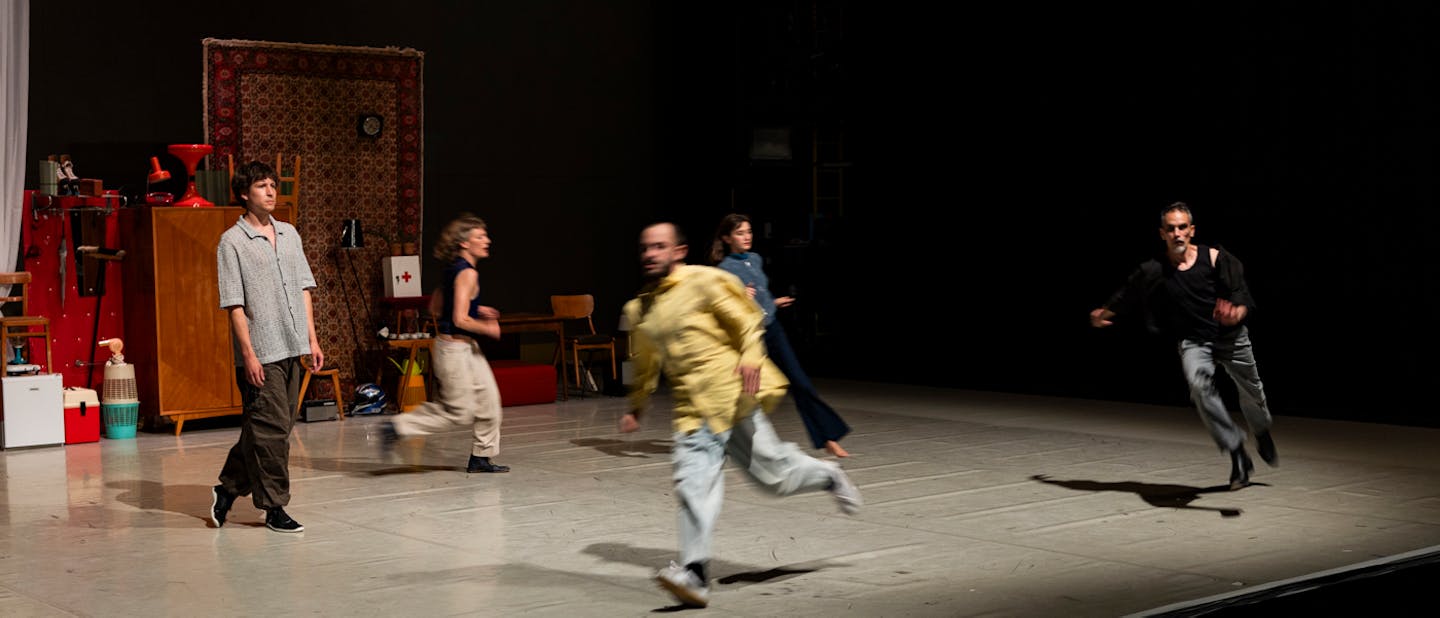
“To fill the hours of the day with this” – a sentence by Jordan Tannahill, is spoken in Slovenian, and appears in English on the wall in Maja Delak's performance. And although the performance is clearly about grief, I am moved by this sentence from the first row because I experience privilege and meaning. Ferenc Barnás, a contemporary Hungarian novelist – who is translated into English, French, German, Czech, Croatian, Serbian and Indonesian – has written many books about death, therefore also about life, and this year at a book festival in Transylvania he said that what is interesting about human beings is that every day they convince themselves that life is worth living. I no longer remember, and it is not important, whether Barnás said it or I added it myself, that art is such an excellent partner in this. But yesterday around 9 p.m., during the performance Declarations, at the end of a day as intense as yesterday, at the sight of this sentence, “To fill the hours of the day with this”, I was filled with a sense of privilege, and I was happy to be alive.
Because the day started early, cloudy, as sometimes feels good, and perfectly suited to discovering the banks of the Drava while running. I am never as motivated to run as when I am in another country. And because this too belongs to the privilege that filled me at the end of this day, I will briefly say that there are years of work and discipline behind the fact that I can put on my running shoes anytime and anywhere, and immediately experience that I am strong, that the world around me is flawless, immediately experience that we are all the same, that it is good to be around one another, if we soften our gaze before we look at each other. Corny, I know, but “This is the thing”.
The afternoon discussion was about the publication of the new issue of Maska Ljubljana magazine. Cripping Performance II is the second issue of Maska magazine dedicated to accessibility, and besides being a more academic, epistemological issue focused on clarifying concepts around inclusivity and solidarity, I received a lifelong experience from the participants of the roundtable. I highlight three things for myself:
The concept of CRIP appears in Alison Kafer's Feminist, Queer, Crip, published by Indiana University Press in 2013, in the compound “crip time”, and deals with exploring the temporal dimension of disability. I think about how discussions of this kind have only ever entered my academic circles in passing, and how good it is that I can expand my bibliography and my vocabulary when I want to think about bodies on stage. (I wrote it down in my Lexicon.)
At the beginning of the roundtable discussion, which I discover is being streamed live, – out of my own ignorance – I am surprised that every participant begins by describing themselves. Height, hair, glasses, clothing colours. And I put together that this is done so that those who cannot see the stream, for example, but are listening to it, can also feel included in the situation. There are also two sign language interpreters present at the venue. One who interprets from a so-called universal sign language into English sign language, and another who interprets from English sign language into spoken English.
What remains with me from Diana Anselmo, one of the contributors to the publication, one of the performers of Pas Moi, a native sign language user, queer performance artist and visual artist, and the main organiser of the inclusive and pioneering Independent Theatre and Performing Arts Festival Repubblica Sorda in Rome, is the following thought – paraphrased: There are national sign languages, and there is one that the Daniel Bongioanni sitting beside them also uses, a universal one, something like Esperanto. This universal sign language has no country and no territory, it is spoken everywhere in the world. And where there is language, there is culture, and where there is culture, there is artistic self-expression. It is necessary and inevitable that Deaf culture should also have its own creative community. Speaking of convincing ourselves that life is worth living, and how excellent a partner art is in that. A little later they speak about community, that the neoliberal, individualist world around us wants us to feel ashamed for needing one another, for needing community. And although these are experiences I have lived privately, hearing them at this discussion I think that solidarity is empathy spreading outward, and that we are all in this together.
Surprisingly few of us attend Dalibor Šandor's lecture performance Dis Lecture On Something Very Special, even though it says right there in the title that it is Very Special. And since we were asked not to spoil it, I decided that I would share something very intimate about this performance.
My greatest fear is that the people who love me and whom I love will one day simply take away, withdraw their love from me. My monster is a thin, crooked creature covered in openly bleeding wounds, bald, hairless and short, with a wide mouth and a soft gaze. Its wings look as though it stole them from a slaughtered chicken and attached them to its back – completely useless. It walks barefoot and quietly. Dalibor, if you are reading the journal: thank you!
And turning toward the evening performance, at the university where I am currently doing my master's degree, associative approaches to playwriting are considered almost devilish, which I assume is because it is worth first practising the kind that is not like that, so that later one may break away from it. In any case, I have written and I write both this kind and that kind, because after all, it is all just a game. Jordan Tannahill, for example, supposedly wrote Declarations during a flight, which – in Maja Delak's direction and choreography – affects me exactly like a short journey through grief, through a panic attack that never ends. It’s confusing. So the performance was as if a fragment had been amplified from a longer grief that had already begun before we arrived, and would continue longer than we would be here. At the same time, somehow gently and unnoticed, I slipped into the attack, and was held throughout. Like the experience of a friend of mine with a fear of flying and the captain: when my friend, as a precaution, informed the captain that she had a flight-phobia and had not flown alone in more than a decade, the captain replied, “you are not flying alone, you are flying with us”. And because the text of the performance is strongly associative, I often dived deep into myself, but the choreography reminded me almost to the second that I was with the actors, that I was with the audience, and pulled me back into my body precisely when I needed it.
Please return to the beginning of the diary, and read the first paragraph again.