June 9th – Guest Journal: Kata Győrfi (Day 1)
I experience theatre festivals as regional, historical, art historical, aesthetic, cultural-political, anthropological, social-psychological, etc. incubators, capsules. And now for the first time I will attempt to think out loud about the series of performances I have seen, about the capsule I have lived through, about the festival experience, and not about the individual performances. On the one hand, somehow it is perhaps more exciting this way, it is unavoidable and it would be a shame not to make use of the succession of the performances, the days, the themes, of the way they respond to one another. If we squint and do not sleep very well, then during the next two weeks we will be watching one long performance. On the other hand, the performances of the first day reminded me of Attila József's Ars Poetica, "Measure yourself against the universe!", he writes, and I will make use of the privilege that I have not written a festival diary for more than ten years, that I can return to this genre almost from outer space, like someone who only has to answer to the universe.
Last night, at about three quarters of the second performance, I wrote down for myself the half-thought that as creators, what responsibility do we bear for the stories we receive. This morning I would somehow pose the question differently, that as artists, what do we owe to those people through whose stories we make a performance about a topic.
Was the afternoon performance about sex work or about those people individually with whom the interviews were conducted? Was the evening performance about migration or about those people individually who sling the world onto their backs and set out upon unknown waters?
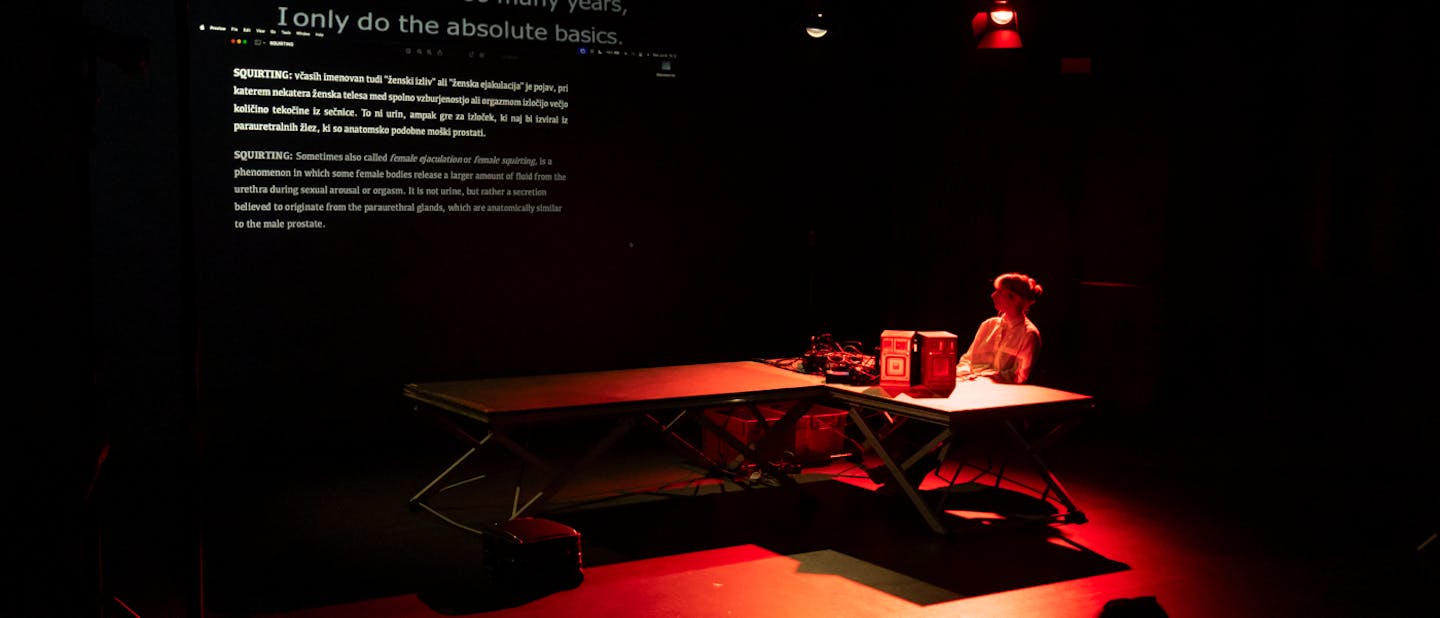
My first question came to me during Now, Suddenly, I Was a Creature of Vice, when Lea Aymard opened her suitcase and took out a pink tulle skirt. The performance must have been about half an hour in when I noticed that up until that point we had practically been listening to processed interview excerpts – that is, I had been listening and reading them in surtitles – and this tulle fabric was the first sign on stage for me that called attention to itself. So perhaps the starting point of my train of thought is primarily aesthetic, because my first naive question was: where is the theatre? Obviously, I know that these are documentary theatre performances, but for the sake of the game, with every single performance as an excuse, I think about theatre itself, and I choose not to immediately place it into a genre, to leave myself the chance to arrive at something general about theatre. Is it nonsense? I do not know. I enjoy myself more this way.
For the stage worlds of Now, Suddenly, I Was a Creature of Vice and A Place of Safety, I would use words such as minimalist, industrial, indicative, symbolic, with a slight bend almost brutalist. Brutalist in the sense of emphasizing rawness and functionality. And perhaps through these two performances the characteristic nature of the documentary genre reveals itself nicely. The Maska production uses digital and multimedia tools in such a way that it leaves me alone with the voices and stories of sex workers in my imagination, and every single person – until Lea Aymard steps onto the stage – has to be created in my imagination. The performance operates its simple, almost purely carrier-like tools in such a way that the performance, the film, takes place in my imagination. It cleans out every preconception, carries me beautifully into my imagination through the voices, which it guides carefully and attentively, there are no sudden movements, everything is organic, I am hallucinating. The tulle fabric is the first occasion when it occurs to me that I am in a theatre. I spent the whole day thinking about what kind of character I should be that day – she says, and I wake up.
The Kepler-452 performance does the same thing, it just gets me there differently. The creation of the performance was preceded by fieldwork, research, real experience. The visual elements are almost real elements of a rescue boat. As if one had been taken apart and poetically rebuilt. If I try to remember, they set me on my journey with the life jacket, and unnoticed, by the middle of the performance I can already see the entire boat before me: tool by tool, material by material, testimony by testimony, they construct the environment before me. And suddenly I find myself seeing the sea before me, the endless water. With minimalist tools, with the measured dosing of indicative industrial materials, they evoke in me one of my most organic experiences: water. And from this point on the performance has an easy job with me, because if there is water, then the boat is already rocking, then there is already fear, anxiety, infinity, death. Anchored in the elements of the performance, my experience expands and grows richer in my imagination, my chest grows warm, my limbs go numb, I am almost seasick when on the deepest boat-metal wall of the stage the first pixel moves in a clearly non-aestheticized recording, and I come face to face with the first pair of eyes. The first real pair of eyes, not evoked by an actor, not created in my imagination, but a pair of eyes that belongs to a real person, who at some point during the last 2–3 years experienced fear, anxiety, infinity and perhaps hope on the Mediterranean Sea. The balloon of art bursts, and everything becomes terribly real.
So my question was wrong from the beginning. The question is not where theatre is, the question is not what theatre owes to the topic or the story, and it is not even a question to whom theatre is indebted. Let us even place in parentheses the fact that documentary theatre is traditionally political, almost investigative, and let us arrive at Attila József: theatre in these performances carries out an important task. Deploying the entire arsenal of tools given by the medium, making use of every possibility of theatre, it captures your attention and mine for that period of time, and turns it toward the smallest details. Toward a dishwashing sponge cut in half, toward flakes of skin stuck between fingers. These performances, and art in general, cannot tell everything about the topic, nor about individual people, but they can do something that nothing else can do: direct my attention toward the light that glows around individual human destinies.