BB/9. On Memory and Timelessness – Report from the Discussion and Roundtable
Day 9 of the festival, June 16, 2026
Theater and Mourning
A discussion about the book in collaboration with the MGL Library
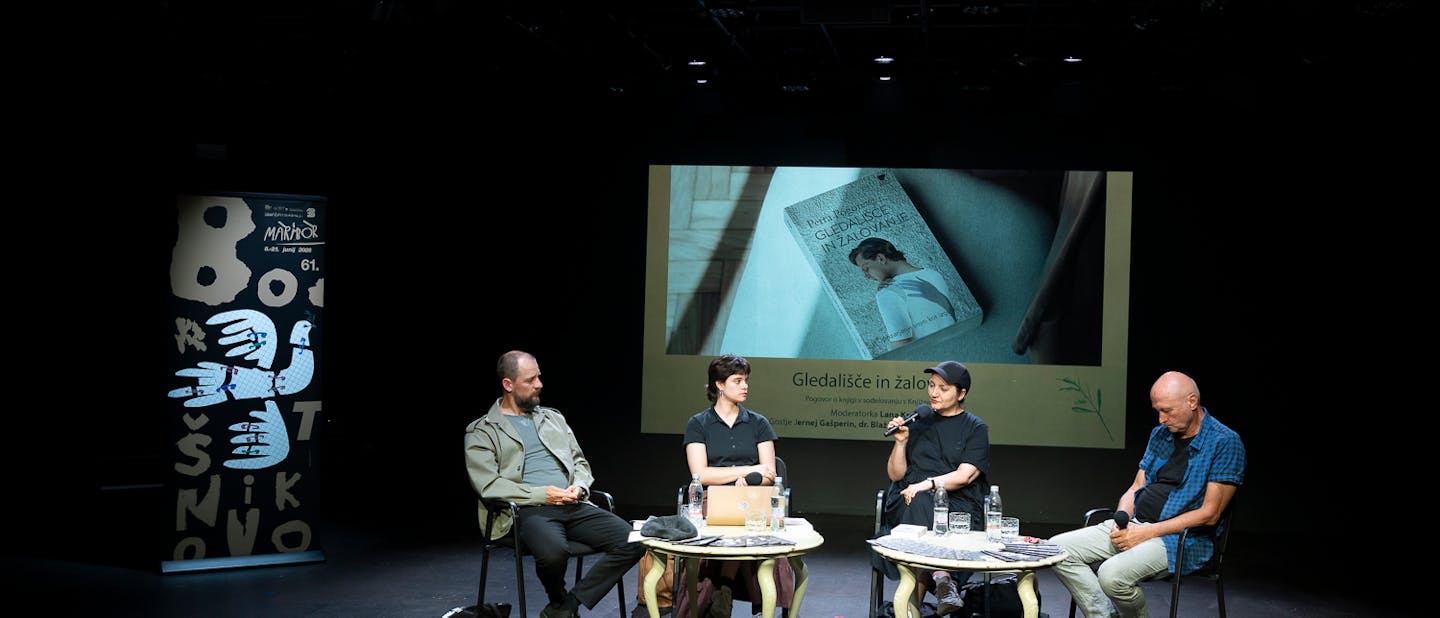
Tuesday afternoon at the festival was dedicated to a discussion of the book Theater and Mourning, based on author Petra Pogorevc’s doctoral dissertation. The discussion was part of a longer series of similar events centered on this book, which was published almost exactly one year ago; a “regular team” of four participants had already been established at last year’s book launch, consisting of: moderator Lana Krmelj and panelists Dr. Petra Pogorevc, Dr. Blaž Lukan, and Jernej Gašperin.
The book highlights five examples of contemporary productions that offer unique perspectives on specific theatrical deaths—Fabrizio Cassol & Alain Platel: Requiem for L., Wajdi Mouawad: The Inflammation of the Verb “To Live,” Milo Rau: Grief and Beauty, Jan Klata: King Lear, and Dragan Živadinov: Noordung 1995–2045. Based on these specific examples, she explores the question of the actual death of an actress or actor and how this impacts the theater, and how mourning, remembrance, and farewell take root within it as a response to the loss. We are, after all, accustomed to seeing Hamlet or Antigone die on stage, but the death of an actor leaves such an intimate and collective shock for all who have lived with or collaborated with them in any way, while also leaving a gap in the repertoire of the theater where they worked—a tangible reminder of the loss of an individual. The book Theater and Mourning is dedicated to the memory of two actors whose deaths shook the Slovenian theater world in 2017—Jernej Šugman, a member of the SNG Drama Ljubljana ensemble, and Gašper Tič, whose home theater, MGL, is also the home of Pogorevc and Gašperin.
This year’s edition of the event was notable for taking place on the Small Stage of the Maribor Drama Theater—the very same venue where, in 2017, a special tribute was held to Gašper Tič, who had tragically passed away that same year. The program of the 52nd edition of the Borštnik Meeting at that time included the play The Advisor, the world premiere of Mile Korun’s play directed by Nina Rajić Kranjac, in which Gašper Tič played the title role. However, since the news of his death shocked the Slovenian public just a few days after the competition program was announced, the festival organizers were forced to screen a recording of the premiere instead of staging a live performance. To ensure that the event wasn’t limited to documentary material alone—since a recording of a performance is always primarily confined to that function—colleagues from his home theater, the Ljubljana City Theater, also staged a live event at the Borštnik Meeting, during which Jernej Gašperin performed his text from the final part of the play, addressing a portrait of Gašper Tič in place of his late co-star.
In her blog post “The Insubstantiality of Feeling, or Hommage à Pandur,” Lana wrote about the personal, sentimental bond that can form between a deceased artist and a viewer who never knew him personally but keeps returning to his performance; for my part, at the roundtable discussion, I experienced a different kind of reliving the presence of someone who is no longer physically among us. Although I never managed to see The Advisor, nor was I present at the 2017 Borštnik Festival—in fact, at that time I wasn’t even aware that I would one day be involved in theater myself—Gašperin’s account of the commemorative event and all the other recollections shared by Petra Pogorevc and Blaž Lukan—combined with the realization that even the location where we find ourselves is no coincidence—evoked a special atmosphere; a kind of eventfulness took place that transcended an academic discussion of the book. We, the listeners of the conversation, found ourselves in a kind of collective remembrance; we were able to take on as our own memories that were not our own, and in this way keep them alive.
Day 10 of the festival, June 17, 2026
Time(less) Brecht
Roundtable organized by the Slovenian Literary Translators’ Association and the Goethe-Institut Ljubljana
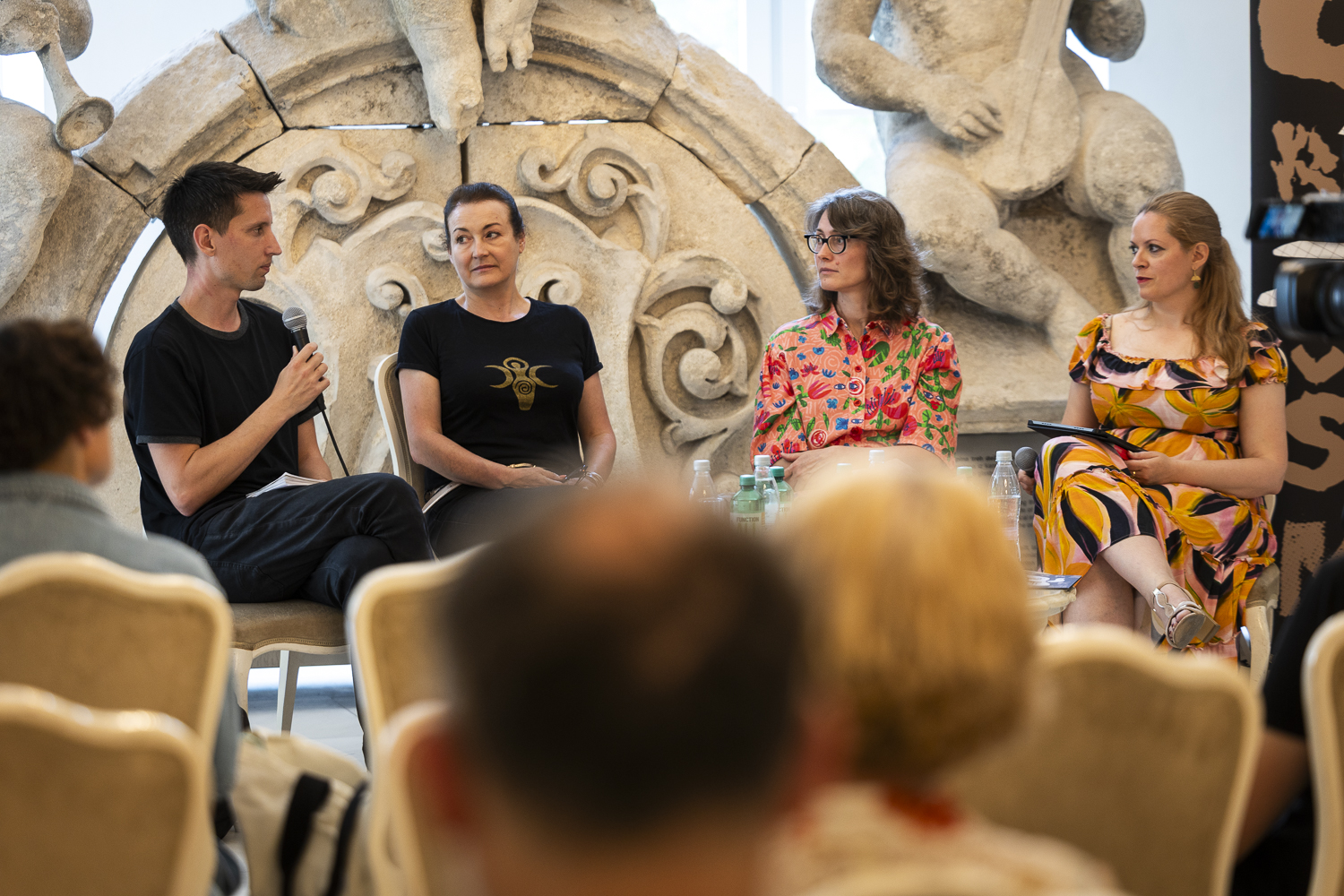
The day’s events kicked off with a roundtable discussion on the translation of Bertolt Brecht’s plays, part of the now-traditional series of roundtables organized by the Slovenian Literary Translators’ Association, which are hosted annually at the Borštnik Meeting; this year marked the fifth such debate on theater translation. This time, moderator Tanja Petrič spoke with translators Urška Brodar and Urška P. Černe, who have translated Brecht’s works for staging on Slovenian stages, as well as with young researchers at the University of Ljubljana’s Academy of Theatre, Radio, Film and Television (AGRFT) and Brecht scholar Jakob Ribič. The event is part of the commemoration of the 70th anniversary of the author’s death, which is accompanied by a year-long series titled “It’s Time for Brecht!”
Jakob Ribič contextualized Brecht’s work for the audience; in particular—and this is crucial to the issue of translation—he presented the history of Brecht’s works being staged on Slovenian stages. Both translators, Urška Brodar and Urška P. Černe, primarily shared their concrete experiences of translating Brecht’s plays—usually commissioned for specific productions—and the related dilemmas tied to the specifics of Brecht’s dramatic language, particularly when it comes to songs, which demand the greatest creative effort from translators. They also touched on the importance of retranslation, since language becomes outdated extremely quickly, especially in theater, while the perspectives of new translators always bring fresh interpretations—as the moderator pointed out, translators believe that the saying “something is lost in translation” is not true, since translation brings much more that is new.
Finally, the participants discussed the title: (Timeless) Brecht—is he truly so timeless, or is he perhaps limited in some way by his historical context? The participants, however, were more or less unanimous in their view that we remain most faithful to Brecht’s work precisely by bringing it up to date and critiquing it, as this is how we keep it alive. Brecht was, after all, an author who rejected ossified tradition, and for this very reason he is considered one of the most important reformers of 20th-century theater; so he would have despised having his works labeled as traditional and placed in a museum display case as untouchable; rather, it is more faithful to Brecht to reinterpret them again and again. In this context, we must also not forget that the commemoration of the 70th anniversary of the author’s death also means that the copyrights to his works will expire at the beginning of next year, which promises exciting new creative reinterpretations of Brecht’s oeuvre.
Manca Tea Devetak
*prevedeno z DeepL AI/translated with DeepL AI. This text was translated from Slovenian using AI tools solely to ensure international accessibility. As a festival that deeply values human creativity and authorship, we thank you for your understanding regarding any linguistic or contextual imperfections.