BB/5. This Story Is as True as It Gets
Day 6 of the Festival, June 13, 2026
Boško and Admira (Slovenian Youth Theater, dir. Živa Bizovičar)
The documentary performance Boško and Admira, directed by Živa Bizovičar, draws its primary inspiration from a 1993 photograph depicting a young couple, Admira Ismić and Boško Brkić—a Muslim woman and an Orthodox Christian man—lying dead in each other’s arms. The photograph of the bodies laying on the Vrbanja Bridge in besieged Sarajevo for seven days, with no one taking responsibility for their deaths. However, this single photograph becomes symptomatic of the broader issue of the romanticization of such tragic images, which occurs when, often without the consent or even knowledge of the subjects of the photographs, they are drawn into the vortex of journalistic sensationalism, where the appeal of the story takes precedence. The bloodier it is, the more likely it is to make the front page—or, to use today’s currency of interest, the more clicks it will attract.
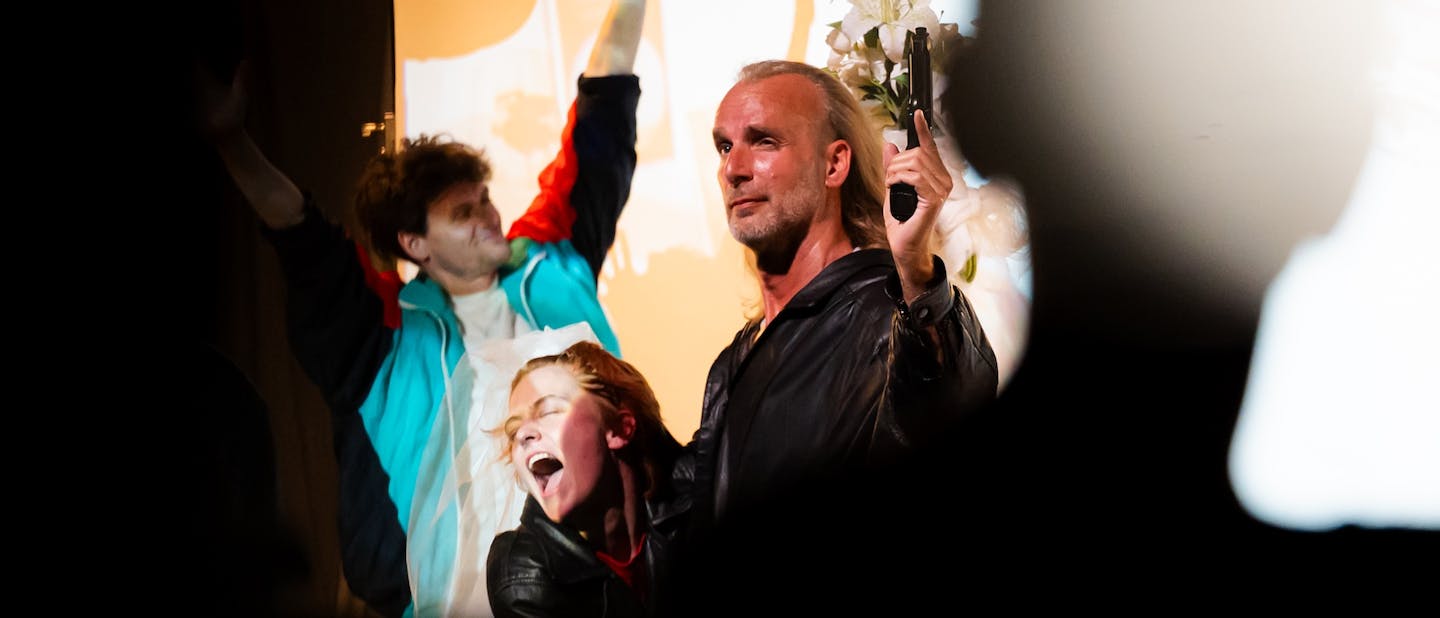
The five performers—Primož Bezjak, Nataša Keser, Boris Kos, Kaja Petrovič, and Stane Tomazin—do not divide their roles along strict lines between individual characters, but rather take turns in a multitude of different roles through which they embody Boško and Admira, everyone else involved in their story, as well as dreamlike scenes of everything that could have been in their lives, foreign journalists fascinated by the photograph of the dead lovers, and, last but not least, themselves, as they examine the context of the photograph. At times, however, the ir bodies become the medium for performative actions, such as testing the distance Admira crawled to Boško’s corpse after they were both shot.
The dramaturgy of the performance (dramaturg Nik Žnidaršič) follows a build-up of tension from objective historical facts to a sensually overloaded chaos evoked by the manifold dilemmas raised by the issues surrounding war photography. First, the production tackles a precise cross-section of the couple’s true story, all the information we have about them, and all the details we can only infer. In the form of seven loops, it deconstructs the circumstances that led to the fateful catastrophe and attempts to present to the audience as vividly as possible exactly what the dark and unsettling backdrop of the tragedy in the photograph is—that it is not merely an image frozen in time, but two people who have been transformed into a symbol, immortalized in a story greater than themselves, even though this is also a journalistic construct. This then raises the question of guilt, which remains unresolved, since responsibility for the act is shifted in such a tense wartime situation; each side can wash its hands of the matter, claiming that “their people” are not to blame for the killing. Moving forward, the story of Boško and Admira becomes merely a symptomatic example of the issues surrounding war photography: what its purpose is, where ethical boundaries lie, and what distinguishes stories that must be shared with the world from sensationalism or even the glorification of war violence.
The performance primarily plays with various formats of presenting documentary content, ranging from narration to dramatic reenactments of statements by real individuals, supposedly authentic footage, music inspired by Boško and Admira’s story, to the aforementioned performative moments designed to convey a more physical experience of reliving their story. An important object that captures the plurality of perspectives and the sense of the media cycle through which we experience distant tragedies is the camera lens (video and set design by Dorian Šilec Petek). One of the more interesting and multifaceted techniques is the podcast format with which the performance begins. The actors, speaking in English with an American accent and maintaining a correspondingly almost perverse distance, tell the tragic story of the “Sarajevo Romeo and Juliet”—a name bestowed upon them by photographer Mark H. Milstein and journalist Kurt Schork, the two Americans who created this sensationalist story of love during wartime. Through the format of the podcast, the question of listener or viewer responsibility arises when we follow such stories in these or similar processed and neatly packaged forms, which serve a morbid fascination with cruel fates rather than providing genuine reporting on global events.
When it comes to confronting one’s own position as a detached observer of wars and other horrors around the world from a comfortable, safe vantage point, it is also worth noting how the very way we engage with such images has changed over the generations. Until recently, their dissemination was predominantly the domain of print media, and the stories surrounding them were crafted by professional journalists; consequently, far fewer such photographs circulated, and many more people encountered them through these same media. Today, however, this discourse has become drastically pluralized; our personal mobile devices have become the primary medium for disseminating the horrors of war, and private individuals now serve as the channels for their distribution. Consequently, the mechanisms at work today function differently: instead of creating a sensationalist narrative based, for example, on a single photograph, we are confronted with numbness resulting from the fact that images of horror overwhelm us from all sides, often as soon as we open our eyes in the morning, at the same time, due to the flood of AI-generated photographs, doubts about their authenticity are arising more than ever before. While Boško and Admira does not explicitly address these specific contemporary journalistic issues, it offers a nuanced reminder of all past and present wars that concern us, thereby prompting reflection on our own position and the stances we advocate.
What remains after the applause dies down is, above all, the realization that there are thousands of such stories. That they did not remain stuck somewhere in the 1990s or the 1940s or in any other “never again” that keeps repeating itself over and over. Such stories are happening today and more vividly before our eyes than ever before, and the mechanisms that spread their stories are no less prone to the pop fetishization of real fates. Boško and Admira thus transcend the symbolism of love in wartime—a theme on which numerous artistic reinterpretations of the young couple’s story have settled, as the production also highlights—and become a poignant reminder of our responsibility and respect for the stories of real people who found themselves caught up in the cruel machinery of war.
Manca Tea Devetak
Distance traveled to the performance: 133 km
Travel time: 1 hr 58 min
*prevedeno z DeepL AI/translated with DeepL AI. This text was translated from Slovenian using AI tools solely to ensure international accessibility. As a festival that deeply values human creativity and authorship, we thank you for your understanding regarding any linguistic or contextual imperfections.