BB/4. A Feeling That Doesn’t Deceive, or A Homage to Pandur
Day 4 of the festival, June 11, 2026
Roundtable Discussion: Pandur’s Theater: “Stop, Moment, How Beautiful You Are!”
Opening of the exhibition Searching for and Defining Beauty
Immaculata (SNG Maribor, dir. Livija Pandur)
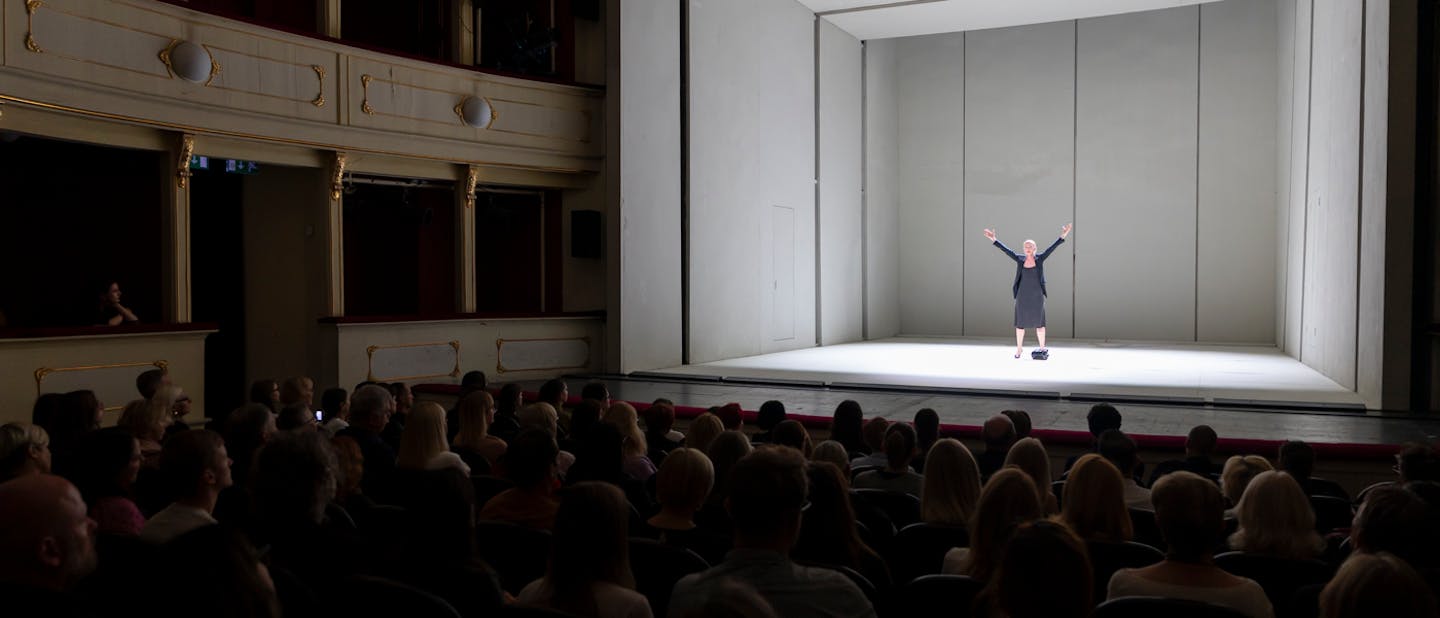
It seems to me that Immaculata is a production I keep returning to. Literally and metaphorically. Yesterday I saw it (at least I think so) for the sixth time, and this time, too, the viewing was connected to an actual return to Maribor. Yesterday from Berlin (starting a festival after a 13-hour night ride on the Flixbus is a challenge in its own right), in 2023, for example, I saw it when I came to visit from an exchange programme in Prague; once I drove all the way from Ljubljana just for a single evening to see it – and if I try to recall the first time I saw it, it seems to be buried deep in my memory, and I can’t pinpoint it exactly. I remember the feelings after seeing it much better, and with that, a certain “previous” version of myself. Or rather, a different version of myself – or rather, my way of watching theater back then, as well as my understanding of the world and, ultimately, of myself. If you ask me what exactly it is about the production that makes me return to it, mentally and physically, in strange cycles, I don’t have a coherent answer. But I do know that seeing Immaculata again is a kind of call.
In general, I find rewatching any performance to be something special, even though many people might see it as pointless or unnecessary. If, in search of a sense of pleasure, I return (and I believe I’m not the only one) to the same TV shows or movies over and over, then I don’t understand why it should be any different with theater. Here, it’s not so much about comfort, nor about admiration or the expectation of ever-new enchantment; it’s more about chasing the feeling that there is something more out there. Not within the performance itself, nor in its text or aesthetics, but within me as I watch it or within each and every individual who watches it. As if it were a fluctuation between the interior and everything that surrounds me, between the individual and the collective, between “being alone” and “being together” . Yes, Immaculata gives me the feeling that within the spaces of the imagination I can reach for something that otherwise seems invisible, intangible, unknown. This is a sentence I uttered (and perhaps thereby admitted?) after last night. It relates to the roundtable discussion, which, together with the exhibition opening in the foyer of the main hall, served as a sort of introduction to the performance, since yesterday’s festival day was dedicated to Tomaž Pandur.
At the roundtable, moderated by Vesna Milek, with Livio Badurina, Ksenija Mišić, Livija Pandur, and Branko Šturbej, there was a great deal of talk about how, in the company of Tomaž Pandur and within his creative processes and performances, everyone had the feeling of discovering previously unknown corners of their unconscious, that there was truly something magical about it all. Stories from festivals and guest performances, especially in Latin America – which simply adored Pandur – also spoke precisely of this. About the magic, the enthusiasm, the peculiar hysteria – if we can call it that – which, from the perspective of someone much younger (like myself), might seem like exaggerations, but yesterday’s conversation convinced me otherwise. It was fascinating to hear that someone dared to dream as much and as boldly as Pandur, that he aimed high, believed in it, saw it, and then actually achieved it. That throughout all of this, he was incredibly respectful toward his colleagues, that he was a perfectionist (which I, being a perfectionist myself, took special note of), and was exceptionally hardworking, while making every member of the team (creative, artistic, technical…) feel important or even indispensable. That he was always looking for something more, something else, something different, something new. That in doing so, he also invented something new, different, and more. It was emphasized several times during the conversation that Pandur was an exception in all of the above, and thus also in directing. That, perhaps without even realizing it himself, he sparked something special in the people around him.
Ksenija Mišić, who had known Pandur since elementary school, spoke about the books that everyone in their “circle” had read and was familiar with, about the movies and plays they’d seen together – shared references, in other words – which were ultimately so deeply ingrained that they could converse almost in code. This got me thinking about collective work (which theater work always is) in general – how long it takes, how many moments spent together are needed, how many shared TV shows or movies are needed for a (non)random group of people to bond enough to understand each other so well? Is this a matter of bonding through shared interests, or is the initial shared interest – that is, theater – essentially what brings people together and, in its own way, draws them toward increasingly similar and ultimately identical points of reference? A shared frame of reference is something I consider essential for working in the field of theater; at the same time, in an era of pronounced individualism, permeated by an epidemic of loneliness and alienation – primarily due to digital technologies – it is also something that calls for radical changes – or that can, especially after hearing the anecdotes, stories, and thoughts from yesterday’s roundtable, encourage us to try to return to a time long past. I realize how utopian this sounds, but lately it seems to me that a return to “old” habits – whether through less digitalization, fewer artificial intelligence tools, more spontaneous knocks on neighbors’ doors, a greater sense of community, or more late-night gatherings – is increasingly the answer to the intimate (in relation to others, larger, political, global) problems of today’s world.
The question that sort of opened the roundtable discussion was what remains for the artist, specifically the director, after they die. Pandur himself is said to have pondered this during his lifetime. In this context, I found it more interesting than the question itself to imagine a man who, at the peak of his career and amidst the enormous success of his work, grapples with this question. Although there are some obvious answers, such as photographs of performances, recordings of performances, memories, anecdotes, interviews, and the like, it seems to me that none of them is truly the right one. I don’t have the right answer myself, but the feeling I get when I hear about Pandur tells me that what remains with him is an awareness of his own transience, of a kind of finality, and on the other hand, of incompleteness when it comes to exploring and creating theater. It seemed to me that this kind of awareness was present in the air of the Small Stage yesterday, that the words Pandur himself might have spoken were dancing among us yesterday, revealing to us small fragments of what remains. And with that, the magic of a man who, as they said yesterday, was also lonely, was reestablished (again and again). A man who grappled with loneliness and chose to grapple with it, who perhaps precisely because of this (regardless of how exactly we understand this loneliness) knew how to weave a special bond with the audience that drew him toward community or the collective.
Although this account is far more poetic and sentimental than I expected – given that I had never met Pandur – let this bond, which continues to form and extend even ten years after the premiere of Immaculata, a production he himself was unfortunately unable to complete, be the current answer to why I keep returning to this production. After all, it was Pandur’s 2015 production of Faust that led me to pursue theater today. “I cannot say more about this than I can say.”
Lana Krmelj
*prevedeno z DeepL AI/translated with DeepL AI. This text was translated from Slovenian using AI tools solely to ensure international accessibility. As a festival that deeply values human creativity and authorship, we thank you for your understanding regarding any linguistic or contextual imperfections.