June 10th – Guest Journal: Kata Győrfi (Day 2) + A Small Lexicon of Getting Lost and Staring Around
The second day is still a day of getting lost and staring around, when I still have not dared to ask at the reception why lukewarm water is running from the cold-water tap, and when the feeling of foreignness is still joyfully intense. I almost imagine that I am invisible, and even at breakfast I stare at the Hungarian-speaking guests from Hungary as if I were watching some social experiment through a windowpane, as if they were aliens, or as if I were the alien. It does not matter at all. Do you know that feeling when everything is new, everything is wonderful, amazes you, and seemingly you have no purpose except to discover the world that is right in front of you?
In this luna-state I checked at least ten times what time the first performance I had a ticket for started, and all ten times I noted that it started at 7 p.m. And at 6:15 p.m., while drinking my boost cappuccino 10 metres from the theatre, I thought I would make sure one more time about the starting time, and there it stood in black on the white-and-blue ticket: starting time 6 p.m. I recalled that thanks to the former Hungarian theatre magazine 7óra7, I had memorized for life that theatre performances always start at 7 o'clock, and I also recalled that I had immediately memorized for life that theatre performances always start at 7 o'clock, except at festivals. In any case, 7óra7 has not existed since 2017, and I was late for Diana Anselmo's Pas Moi. And the Croatian production Max, Mischa and the Tet Offensive did not have its English subtitles formatted for projection, and I did not dare commit to 3 and a half hours of a presumed prose performance.
A piece of information emerged from a folder from two years ago, when I was at a residency programme in North Macedonia, that people living in the territory of the former Yugoslavia more or less understand one another, Slovenians and Croatians certainly quite well. Before I withdrew to the cabaret concert at the Puppet Theatre by the Drava, I asked Nina, the supergirl responsible for the international guests, in what language the audience discussion of the performances in the competition programme would take place, and I learned that history had arranged things in such a way that I would certainly not understand the professional debate.
In any case, I thought that the diary genre can accommodate a collection which I experienced completely randomly on the day of getting lost and staring around, in the name of curiosity and openness. Being primarily a creator, in every city I am open to art, and most of the time I do thorough preliminary research, as was the case now as well: I marked museums, larger galleries, and monuments on my map, but at noon I set off completely aimlessly toward the riverbank. And completely free from the pressure of finding something, I came across the following places, writers, and artists.
A Small Lexicon of Getting Lost and Staring Around:
Mariborka – a small bookshop where the super kind saleswoman, owner (?) immediately starts talking with me and recommends a newly published anthology of Slovenian poets my age translated into English. And Srečko Kosovel, a Slovenian writer from between the two world wars, about whom she tells me that he died exactly 100 years ago this year, and that I should imagine him as a writer who is always relevant, an experimental creator, who by the way died at the age of 22, and now they have published a small English-language pocket book of his texts, and she thinks his writings are relevant at any time. In the end I buy the novella Ballerina, ballerina by theatre director and writer Marko Sosič, because I tell her that somehow I feel more comfortable in stories, and I ask whether she recommends the author. She says she has not read the novel, but has only heard good things about it. It seems to be a coming-of-age story of a schizophrenic girl. We nod that it cannot be bad. Before I step out of her wonderful shop, where I also see contemporary philosophy and art theory titles and very carefully produced Slovenian translations even of some of my favourite contemporary authors, I notice on the magazine shelf a rolled-up multi-page publication. I ask what it is, she comes over, takes off the preserving-jar rubber band around it, and meanwhile says that it is the latest issue of the Slovenian photography magazine, and that it is so large and soft that it cannot be stored any other way. She opens it in front of me, and I imagine that it should be held in one of those old newspaper-reading butterfly frames that I usually see in libraries. Soft giant newspaper pages filled with incredibly high-quality, high-resolution photographs. I say to myself, this is a wonderful publication. The Slovenian photography magazine, she repeats. It must be very expensive, I remark. No, she says, 14 euros. Somehow this country has the resources for art. I hope the soft newspaper does not get wrinkled on the plane.
Kulturni inkubator – As I step out of the two-person bookshop, fifteen steps away from it, also on the right-hand side, I peek into a gallery (?), where I see miniature drawings exhibited in a large space relative to the size of the drawings. My feet carry me inside on their own, where I become acquainted with the graphics of Marija Janković without having any idea that I am becoming acquainted with the graphics of Marija Janković. What I see before me: comic-like line drawings, incredibly detailed recordings of moments, living spaces, relationships, almost medallion-like compositions, world-buildings that seem like card illustrations, where prudery has no place, where nudity and sexuality exist in the most natural intimacy with animals, jewellery, and religious symbols. A parallel friendly, mystical, symbolic, pictogram-reality.
Fotografski muzej Maribor – This is almost exactly what it seems to be, except that it is the collection of a likeable Slovenian-born photographic equipment dealer who emigrated to America after the Second World War, which he and his Mexican-born wife assembled during their life together, and which collection of 1645 items they donated to the city of Maribor on the two conditions that it be properly exhibited and that it bear the name Avgust and Maria Bohanec Collection. To walk around inside lives like these is a privilege.
Umetnostna galerija Maribor – Slovenia's second largest museum of modern and contemporary art, which collects the works of Slovenian visual artists from the nineteenth century to the present day. This was obviously already on my map marked with a little green flag, and since I was very close, I walked in. Without claiming completeness, I will list four artists who caught my personal interest and whom I recommend for staring around.
Metka Krašovec, for example, made drawings inspired by the poems of Emily Dickinson, as a consequence of which contemporary American poets began responding with poems to her drawings, and everything was published in a volume entitled The Heart's Many Doors: American Poets Respond to Metka Krašovec's Images Responding to Emily Dickinson.
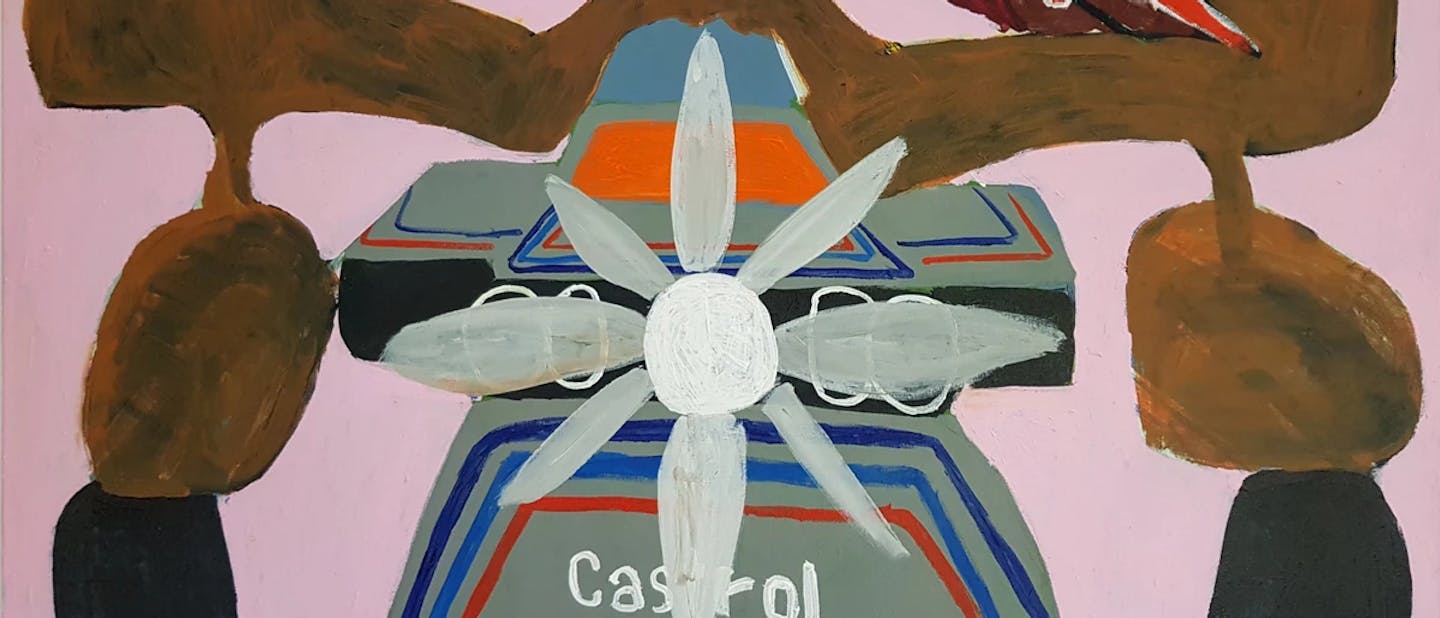
Samuel Grajfoner's giant prints that look like graphite-granites, which somehow feel simultaneously calming and unsettling – with exactly the same intensity. Zmago Jeraj's otherworldly nocturnal scenes, whose subjects seem as if they have come up from the depths of hell to sit for a portrait. And Matija Bobičić, the Balkan Basquiat of my generation, in whose works I recognize the cartoon characters of my childhood, but now I know as well that these are not merely characters, because we have grown up, and they have remained with us as distorted totems, multi-headed pop-gods, who simultaneously represent our childhood and adult anxieties, that just as in the 1990s, my generation is still not always certain now – just like the Aztecs – that there will be a sun tomorrow.