1973
16:00
Premiera Première 1. 2. 2025, Mali oder SNG Nova Gorica
Running time is 4 hours and 30 minutes with two intervals.
Slovenian, Italian and English languages, with Italian, English and Slovenian surtitles
Post-performance discussion with the artists.
Director and dramaturg Tomi Janežič
Set designer Branko Hojnik
Costume designer Marina Sremac
Composer Samo Kutin
Video designer Carlo Zoratti
Assistant directors Tjaša Črnigoj, Mojca Madon
Assistant set designers Katarina Prislan, Lara Reichmann
Assistant costume designer Slavica Janošević
Language consultant Anja Pišot
Lighting designers Tomi Janežič, Branko Hojnik
Sound designer Gašper Torkar
Camera operator Stefano Giacomuzzi
Video sound technician Renato Rinaldi
Sign language consultant Tina Strel
Cast
Tamara Avguštin as guest, Ana Facchini, Arna Hadžialjević, Patrizia Jurinčič Finžgar, Anuša Kodelja as guest, Helena Peršuh, Matija Rupel, Marjuta Slamič, Žiga Udir
The production uses original music by Mulčer (Samo Kutin, Andrej Fon and Szymon Gasiorek) and compositions by Samo Kutin, co-authored with Enja Grabrijan.
Other musicians who collaborated with Samo Kutin on the score for Dodecalogy 1972–1983 are Jure Boršič, Kaja Draksler, Jošt Drašler, Vid Drašler, Andrej Fon, Szymon Gasiorek, Iztok Koren, Ana Kravanja, Dejan Lapanja, Eduardo Raon and Tea Vidmar.
The production also uses the music from Tomaž Pengov’s album Odpotovanja and other music from 1973.
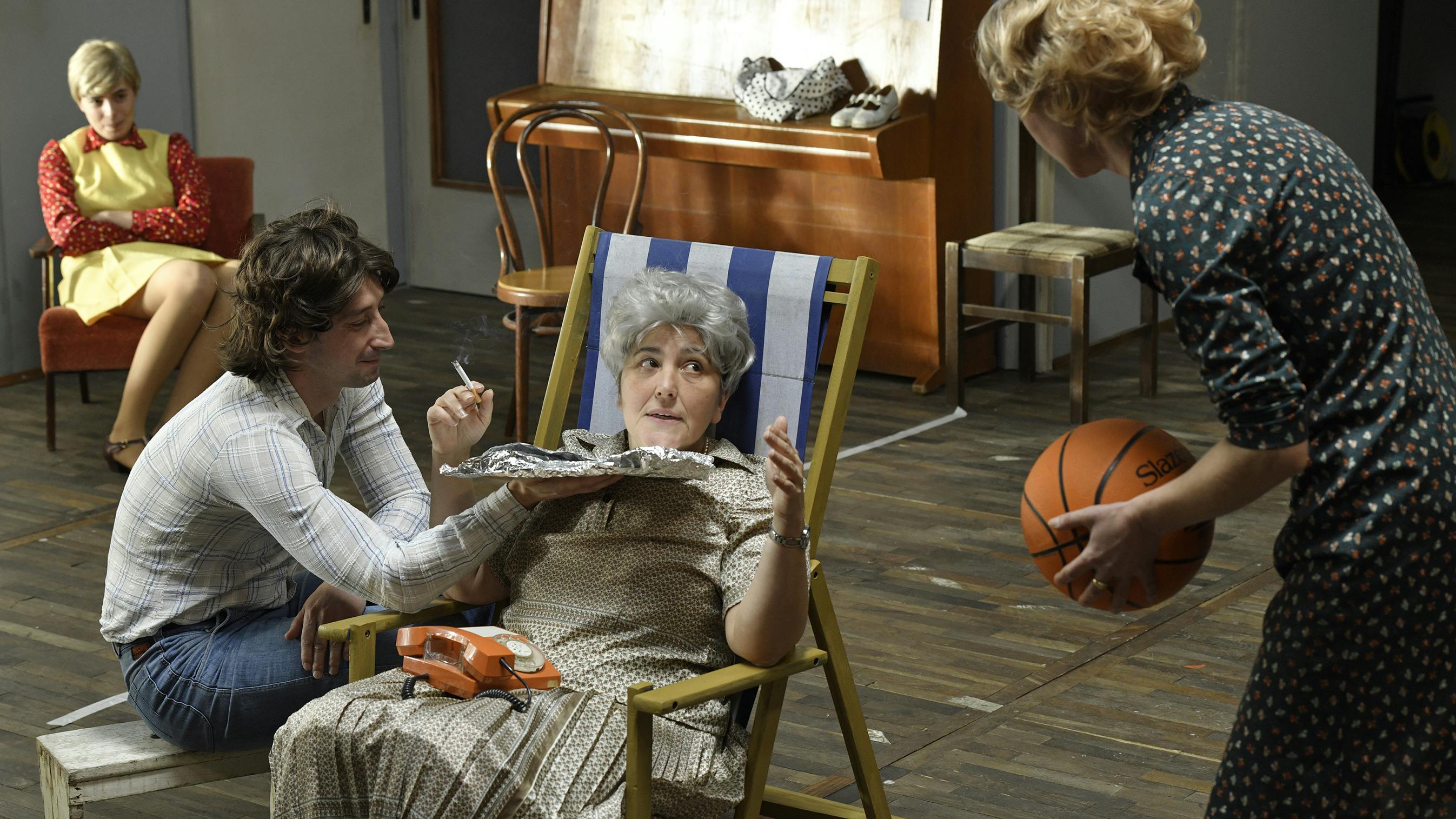
1973: the year in which Yugoslavia becomes the FIBA EuroBasket champion, Fellini makes Amarcord, Pink Floyd release The Dark Side of the Moon, and Tomaž Pengov his unforgettable album, recorded in his lavatory. The American Psychiatric Association declassifies homosexuality as a mental disorder in its Diagnostic and Statistical Manual of Mental Disorders, the American intervention in the Vietnam War ends, the first call on a mobile phone is made in New York, and a day later, the World Trade Center opens. The Mushroom Pickers’ Club in Nova Gorica is established and the Athletic Club Nova Gorica celebrates its first decade. Nova Gorica hosts the sports meet of the wood industry workers from the entire Socialist Republic of Slovenia.
1973 is a transgenerational documentary fiction based on the personal stories of its creators. The stories of the 1970s grew out of the flats of the 1970s and connect to many local and global events. The production is a part of the theatre Dodecalogy 1972–1983, which sketches a network of life destinies stretching through time, destinies marked by travels and migrations. But above all, it is an omnibus about theatre itself.